Structure of a GUF File
Every GUF file consists of two sections: The Header section and the Binary Data section.
The Header section gives information about the binary content in the Binary Data section in form of key - value pairs, similar to a Python dictionary. The meta information is stored in humanly readable ASCII and has (at least) 256 bytes. However, it must not be edited, as the header must correspond to the binary data.
The header consists of several blocks and always starts with the GUF version consisting of the file format and its version. The example below is GDT3, i.e. a version 3 *.gdt file. This is the default *.gdt file format for GeoDict structure files since GeoDict 2023.
 Creation Data
The Creation Data block provides information about the creation of the file, e.g. the creation time and the used GeoDict revision.
|
Image Data
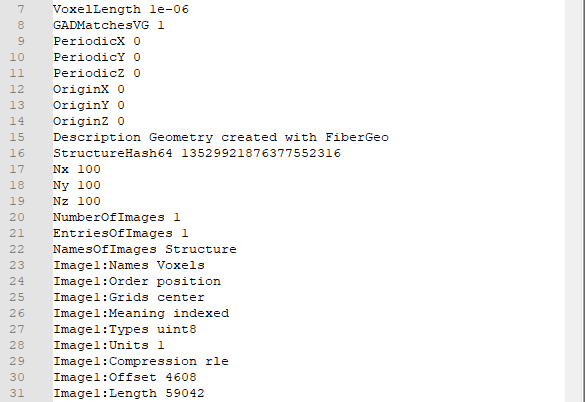
Detailed information about the Image Data is given afterwards. Image Data is stored in a sequence of images as fields.
A full image has Nx by Ny by Nz entries, corresponding to the domain size of the structure / result field in voxels.
The example file has 100 voxels in X-, Y- and Z-direction and one image with the name Structure.
|
File Specific Data
At the end of the header, File Specific Data blocks can be found, e.g., map data, info data, and array data.
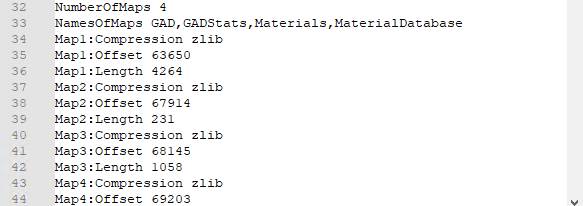
Additional data in *.gdt files is described by stringmaps, that are maps consisting of key-value pairs, similar to a Python dictionary. Thus, the specific block in the example contains map information.
|
Binary Data
In the example file, there are four maps with the names GAD, GADStats, Materials and MaterialDatabase. The Binary Data section of the example file is shown here.
|
Volume Field Data
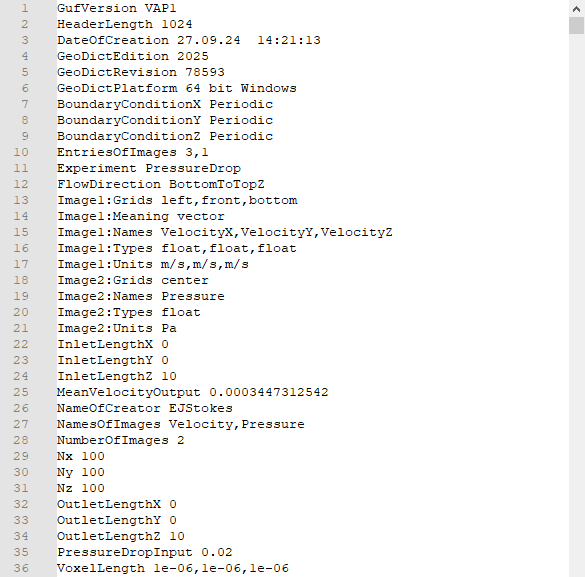
In a second example, a flow simulation was run on the structure. The GUF file FlowField_z.vap file is produced and shown here.
The flow was computed in Z-direction. The file contains two images with the names Velocity and Pressure. The velocity image contains three fields and the pressure image one. The velocity fields are called VelocityX, VelocityY and VelocityZ.
|
Particle Specific Data
Result files generated by the particle tracker in FilterDict and AddiDict (*.gpp) contain a large information block providing details about the simulation.
The particle positions are described by arrays. The example file contains one array with 12 columns and 3600 rows.
|