Structure Information
The Structure Information command determines porosity, solid volume fraction (SVF), density, mass, and grammage in all three spatial directions for the volume inside the bounding box. For these calculations, the algorithm requires the density of all solid materials as input data.
To illustrate the command the structure shown below is used.
After clicking the Edit… button, the Structure Information dialog opens. At the top of the dialog, replace the default Result File Name by a name according to your current project. The result file is saved in the chosen project folder (File → Choose Project Folder in the menu bar).
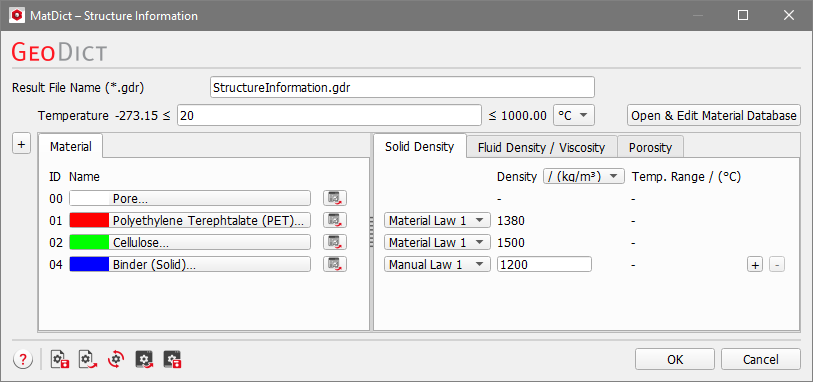
The given Temperature value and the Temp. Range are only of importance if the solid density is defined as a temperature-dependent quantity in the GeoDict Material Database. For example, if Aluminum would be chosen as material, the solid density would be temperature dependent. In the above example, the densities of the PET and cellulose fibers are not set to be temperature dependent.

You can get direct access to the Material Database by clicking on Open & Edit Material Database.
Underneath, the Material panel contains the Material IDs of the constituent materials present in the current structure. By default, Material IDs that are not present in the structure are not displayed under the Material tab, but they can be displayed by clicking on the “+” symbol to the left of the Material tab.
 How to change the constituent materials

On the right, the Solid Density tab contains the density information of the materials for each of the present Material IDs. The density can be given in kg/m3 or g/cm3. For materials that are defined in the Material Database, the density of the material is directly shown under Density in the row for that Material ID. If multiple Material Laws are defined for a material, select which law you want to use for the computation.
If a material is set to Manual, the Material Law changes to Manual Law and more laws can be added or deleted by clicking the “+” or “-“ button on the right of the corresponding row. You can enter the density for manual materials directly in the Solid Density tab. In the example above, the binder material of Material ID 04 is a manual material.
|
Know how! New in GeoDict 2025: You can define density for fluid materials and set the porosity of porous solids. |

If fluid materials are present in the structure, you can define the density of them in the Fluid Density / Viscosity tab in the same way as for solid materials.

If porous materials are present you can define how much of the material are pores in the Porosity tab if it is a manual material, otherwise you have to change it in the Material Database.

Topics of this section |
|---|
|
