BatteryDict
BatteryDict simulates the performance of secondary lithium-ion batteries during charging and discharging on the micro and meso scale. With the Battery Designer, virtual cells can be created, based on 3D structures of electrode materials with a representative elementary volume (REV). The numerical calculation of the electrochemical processes governing ionic transport in the different material phases and across their interfaces are based on local charge and neutrality together with a Butler-Volmer reaction model.
A battery cell in BatteryDict consists of four different components: cathode, anode, separator, and the current collectors. The current collectors are represented as standardized layers, while the separator can be modeled as an effective material. The cathode and anode are individually modeled structures, consisting of multiple active materials, binders and other conductive additives, and electrolyte. Up to four different active materials and, since GeoDict 2025, up to four conductive additives and binders can be processed for each electrode. It is also possible to perform half cell simulations for single electrode structures, without designing the complete half cell first.
It is possible to run a fully resolved simulation on the created microstructure. This very accurate solution provides results that are fully resolved on the micro scale. Two solvers are provided for fully resolved simulations, the LIR solver and the BESTmicro solver (known as BEST:er-micro in GeoDict 2023).
BatteryDict additionally allows to run homogenized simulations with the BESTmeso solver that are much faster than the fully resolved simulation. A homogenized model that is created from the given battery structure is used in this case with effective parameters computed in GeoDict.
It is additionally possible to define charging profiles with different stopping criteria. This functionality is especially useful to simulate consecutive charging and discharging processes in the battery.
The relaxation of a battery cell after charging or discharging can be simulated as additional steps in the charging profiles.
The functionality to compute mechanical deformations of a battery cell due to Lithium intercalation (BatteryDict-Degradation) is also possible. This add-on to BatteryDict allows to study mechanical stresses and strains due to deformations of the active materials in the battery cell from a previously run charging or discharging simulation.
The input data for the electrode models can be either scanned data from µCT or FIB-SEM images of real cathode and anode materials, or realistic structures created in GeoDict. BatteryDict is capable of handling voxel-based structures, with a volume large enough (REV) to simulate the behavior of a real battery electrode. For each active material, the Open-Circuit Potential (OCV) curve can be specified and the characteristic values for ionic and electronic transport in the active materials, electrolyte and binder or binder and carbon black (represented as one CBD-phase), respectively, can be set. The separator and current collectors are represented as homogeneous materials with a specified thickness.
The models used for simulation and the parameters to be defined are explained in more detail in the section Theoretical Background. The different simulation options are outlined in their corresponding topics (see list of topics below). The results of the simulations and their interpretation are discussed.
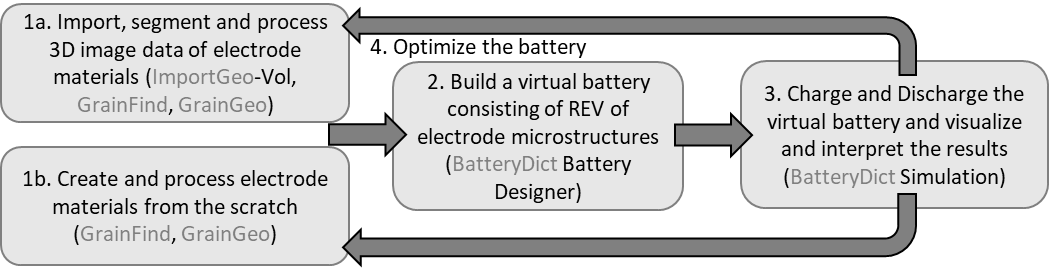
The characteristic application for BatteryDict is to simulate and optimize the charging performance of a battery cell, based on realistic electrode microstructures. To analyze or model electrode microstructures, also the use of other GeoDict modules is emphasized. Many properties of the microstructure are vital for the performance of a battery, like porosity, pore size distribution, surface area, tortuosity, thermal conductivity, thermal flux, electric conductivity, electric flux, thermal expansion, permeability, diffusivity, etc.. The GeoDict modules GrainGeo, GrainFind, PoroDict, FlowDict, DiffuDict, and ConductoDict can be used to analyze these properties and to obtain detailed information about the microstructure of the electrodes.
With ImportGeo-Vol, 3D image data can be imported and segmented and be further processed with the modules mentioned above. GrainFind and GrainGeo are powerful tools to create Statistical Digital Twins based on image data or realistic microstructures from scratch.
Learn to use BatteryDict: |
|---|
|
|
Join the conversationVisit the Community on GeoDict Forum to be inspired and get answers to top questions. |

