Particle Tracking
FilterDict simulates filter clogging and tracks how particles are caught in the filter. The movement of particles in the fluid is influenced by the following factors:
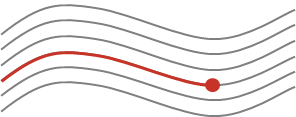 |
Drag forces are the dominant forces in most cases, and particle trajectories are close to the streamlines of the flow field |
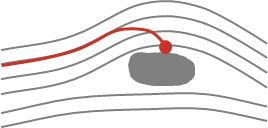 |
Electrostatic effects. The particles and pore surface can be electrostatically charged. This leads to attraction or repulsion effects. |
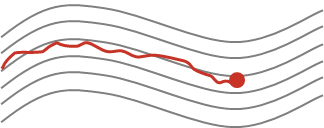 |
Diffusive (or Brownian) motion. Particle collisions with fluid molecules lead to small random direction changes. |
FilterDict simulates the filtration process considering these three effects. Electrostatic attraction and/or diffusive motion can be switched off if is known a-priori that these effects have no influence on the filtration process. Overall, the particle movement is governed by
Particle Momentum = Stokes Drag + External Forces
or, as formula:
In the friction coefficient
the particle radius is optionally corrected by the Cunningham correction factor,
to account for the reduced drag of very tiny particles that may easily pass between the molecules of the surrounding fluid. The particle diffusivity computes Brownian motion through
The simulation of Brownian motion can be disabled by the user. In that case the diffusivity is set to zero. External forces are the electrostatic force and an additional force field which is
by default. When the user disables electrostatic effects, the electrostatic field is set to zero.
Equations (243) , (244) , (245) and (246) can be changed through user defined functions, e.g., to include gravity or buoyancy forces in .
The used variables and their units are:
Symbol |
Unit |
Meaning |
|
Symbol |
Unit |
Meaning |
m/s |
particle velocity |
C |
particle charge |
|||
m/s |
fluid velocity |
V/m |
electric field |
|||
kg/s |
friction coefficient |
J/K |
Boltzmann constant |
|||
kg/m·s |
dynamic viscosity |
3D Wiener measure |
||||
m |
particle radius |
K |
temperature |
|||
1 |
Cunningham correction factor |
m²/s |
diffusivity |
|||
kg |
particle mass |
N |
external force |
|||
m |
mean free path |
The electrostatic charges are assumed as constant given forces on the filter surface. A constant charge density is assigned on all voxel walls. The electric field
is determined by solving the Poisson equation for the potential (unit:V)
where is the surface charge density (unit: C/m²) and = 8.854188E-12 F/m is the permittivity. Here, denotes the filter surface and is the Dirac distribution.
Here, is periodic in the tangential directions and should satisfy zero Dirichlet boundary conditions at and in flow direction. Numerically, infinity is replaced by and in the z-direction.
By construction, these boundaries lay away from the filter material and there is no conflict between singular forces on filter surfaces and these Dirichlet conditions. Due to the periodic boundary conditions, the potential feels a non-integrable amount of charges and tends to infinity in the filter as the Dirichlet boundary is moved away from the filter.
Thus, the potential depends on the position where the Dirichlet condition is located. However, only the electric field is needed to determine the movement of the particles in equation (242) and this remains almost unchanged from the location of the Dirichlet boundary as soon as this boundary is sufficiently far away from the filter material.
