Checklist for Structure Parameters
The parameters for structure generation must be chosen to match the properties of the target scan. Ensure to cover the complete required parameter space, by capturing all variations observed in the target materials.
In the following a parameter checklist is given:
- Voxel length (resolution)
- Solid volume fractions for the different materials
- Object diameter ranges
- Object shapes
- Object orientation distribution
- Object overlap (set overlap not larger as is necessary to represent artifacts in the scan)
- Fiber curvature
- CT artifacts (e. g. hour glassing and fiber crossings)
- Contact angle of binder
- Binder anisotropy
- …
The numbers of voxels in the X-, Y- and Z-direction define the Domain Size and should already consider the Window Sizes used for training. For example, for the default window size of 52³ voxels, a domain size between 256³ and 512³ voxels is recommended. Larger structures require higher hardware resources.
Make sure to check on boundary effects when generating structures. Cropping the structure with ProcessGeo → Crop may be necessary in some cases to avoid them.
Usually, if the different material phases or the individual fibers can be recognized by eye, the neural network can also learn to distinguish them. Otherwise, if for example the binder solid volume percentage is very high compared to the object diameters, the objects can “disappear” inside the binder. Then, it is nearly impossible for the network to identify the small objects inside the binder.
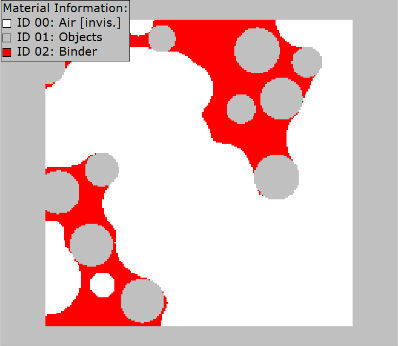
Avoid large parameter ranges, since the training of the neural network would become very difficult. Consider for example a fiber structure with binder. If there are fibers with very different diameters, probably many of the thicker fibers will be recognized as two thinner fibers with binder in between and the other way around.
Make sure to remove the overlap, only leaving the amount of overlap that is necessary to represent artifacts in the scan.
