Grain-Fragment Reconnection
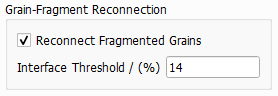
In some cases (e.g. for complex grain shapes), the watershed algorithm in step 1 tends to over-segment the grains. This means, that sometimes grains are identified as multiple grains (Fragmented Grains) when, in fact, they may be a single grain with a complex shape. Activate the checkbox Reconnect Fragmented Grains to merge connected grains depending on the value chosen for Interface Threshold.
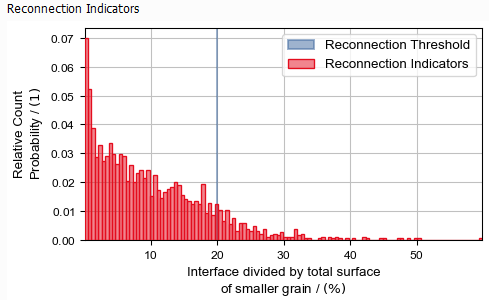
The probability that two grain fragments belong to the same grain is measured with the interface ratio. This interface ratio compares the interface area of two touching grain fragments with the surface area of the grain fragment with the smaller surface.
For the computation of the interface ratio, the grain surfaces and interfaces need to be computed. The surface area estimation is based on Estimate Surface Area from MatDict (see also J. Ohser, F. Mücklich).
If the interface ratio is larger than the percentage chosen for the Interface Threshold, the two grain fragments are merged and only one grain is reported as identified.
For example, if the Interface Threshold is set to the default 14, the shared interface of two grains must be larger than 14% of the total surface of the smaller grain for the two grains to be merged. The next example shows two structures in which a big grain and a small grain touch with different interface surface between them. Depending on the surface of the interface, the value of Interface Threshold at which the two grains stop being reconnected and are detected as two (instead of only one) is very different.
When the two grains share a small interface, a low value of Interface Threshold (7) is enough to separate the two grains. When the two grains instead share a large interface, a higher value of Interface Threshold (15) is needed to separate the two grains. The default value of Interface Threshold (14) would be appropriate to separate the two grains sharing a small interface, but not the grains sharing a large interface.
The value for the Interface Threshold must be chosen carefully depending on the size of grains in the structure. With a low threshold, more grains are merged (and less grains are identified).
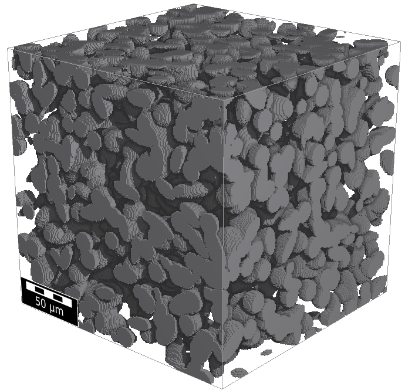
In the figures below (using the visualization of *.g32 files), observe the effect of different choices for the Interface Threshold. For this example, the Minimal Grain Diameter is always 2 µm. With a very low Interface Threshold value of 3%, several large and complex grains are identified in the structure that may not correspond to single grains. With a value of 20%, the grain space may be over-segmented with many small grains being detected.
|
Know how! Use the Reconnection Indicators histogram under the Results → Plots subtab in the Result Viewer to find an appropriate Interface Threshold for the structure. As described above, the ratio of the interface area between two grains and the total surface of the smaller grain is computed. This ratio of all grain interfaces and the selected Interface Threshold are plotted in the Reconnection Indicator histogram. The following ratio histogram belongs to the example structure and the interface threshold of 20% is marked in blue. Observe that many grain interfaces have a ratio smaller than 20%, thus only few grains are merged together.
|