Results
The result file (*.gdr) is opened in the Result Viewer after the computation is finished.
Due to the voxelization, the chord length can only be measured in multiples of the voxel length. A chord length of meters includes all chord lengths with a distance of half the voxel length around . For example, a chord length of 2 µm with voxel length 1µm actually means all chords between 1.5 µm and 2.5 µm.
Report Tab
Under the Report tab, the Mean chord lengths, the Fraction lengths L10, L50, L90 and P10, P50, P90, and the complete Chord length distribution in the selected chord direction(s) are shown.
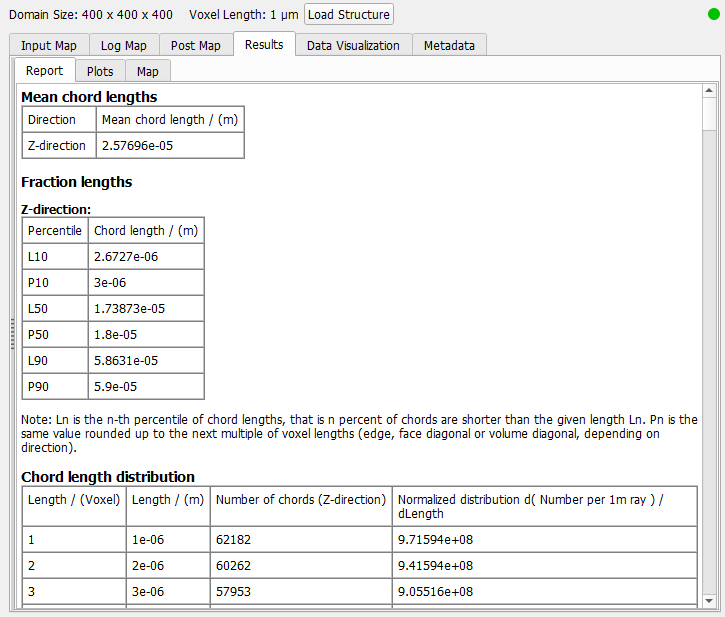
The fraction lengths table reports the chord lengths smaller than 10%, 50%, 90% of all chord lengths (L10, L50, L90). The P-values (P10, P50, P90) are the same, but rounded up to the next largest multiple of the voxel length.
For example, a L10 of 2.6 µm means that 10% of all chords are smaller than this length. A L50 of 17.4 µm means that 50% of all chords are smaller than this length. A L90 of 58.6 µm means that 90% of all chords are smaller than this length.
For P10 the L10 value of 2.6 is rounded up to 3e-6, because the voxel length is 1 µm, and it means that this length (3 µm) is larger than or equal to the length of 10% of all chords. A P50 of 1.8e-5 means that this length (18 µm) is larger than or equal to the length of 50% of all chords. A P90 of 5.9e-5 means that this length (59 µm) is larger than or equal to the length of 90% of all chords.
Plots Tab
The plot of the complete chord length distribution is shown in the Results-Plots subtab.
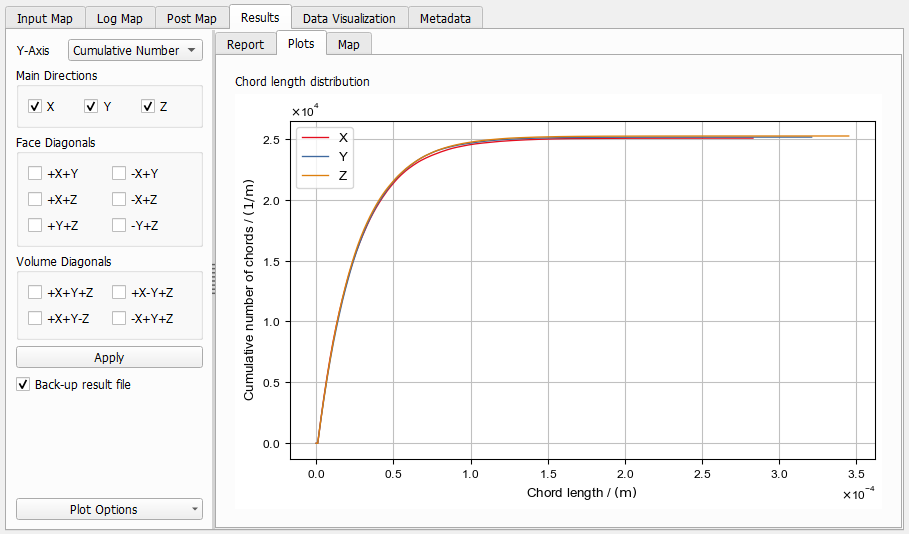
In the context menu on the left, the chord length distribution plot can be customized. For the Y-Axis, the Cumulative Number, the Normalized Number, or the Number of Chords can be selected.
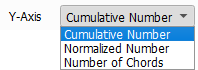
The normalized number of chords is the difference quotient of the cumulative chord length distribution, where the step size is the current voxel length.
The normalized number of chords can be obtained from the number of chords histogram. For example, in X-direction it can be computed as follows: First, the number of chords is divided by NY*NZ, which equals the total number of rays, to obtain the number of chords per ray. Then, this number is normalized by NX*voxel length to obtain the number of chords per meter. As the accuracy of the measurement of the chord length is restricted by the voxel length, the histogram bin size is also given in voxels. To reflect this, the number of chords per meter must again be divided by the voxel length (which equals the bin size) in the last step. This allows to compare results for structures with different voxel lengths.
In addition, if more than one direction was chosen for the computations, it can be chosen for which directions the distribution should be shown (Main Directions, Face Diagonals, Volume Diagonals).
Click Apply… to update the displayed plot.
