Chord Length Distribution
The Chord Length Distribution command is accessible from MatDict and PoroDict.
A Chord Length Distribution (CLD) is the distribution of the length of a typical chord of a structure. By being characteristic for any given geometry class, it is a highly precise and sensitive measure to compare the geometries of porous media. The calculation of CLD is particularly useful in 2D tomographic cross-sections, for which the pore size distribution cannot be determined by granulometry or by porosimetry.
The Chord Length is defined as the number of connected voxels along the computational direction. Pseudo-code of the algorithm used for the computation can be found in J. Ohser, F. Mücklich.
The Chord Length Distribution dialog opens when clicking the Edit… button.
At the top of the dialog, enter the Result File Name. The result file is saved in the chosen project folder (File → Choose Project Folder in the menu bar).
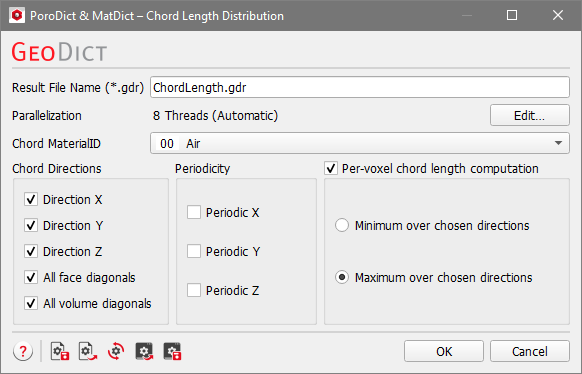

Select the Chord MaterialID for which the chord length distribution is calculated. This can be done for pore or solid materials alike.
In the Chord Directions section, select the direction(s) in which the chord lengths are determined. This can be done along the axes (Direction X, Direction Y or Direction Z), along the two-dimensional diagonals of the domain (All face diagonals), or along the three-dimensional diagonals of the domain (All volume diagonals).
Periodicity can be applied in the X-, Y-, and/or Z-direction for the calculation. Periodicity means, that chords continue on the opposite side of the domain. This can lead to infinitely long chord lengths, if a complete ray along the chosen direction is inside of the selected Chord MaterialID. Such chords are neglected when computing the distribution results, and a warning is plotted on top of the resulting report if this occurs:

Check Per-voxel chord length computation to include a scalar field for the output in which, for each voxel, the length of the minimum or maximum chord through that voxel over all chosen directions is stored. For this, choose between Minimum over chosen directions or Maximum over chosen directions.
Topics of this section |
|---|
|
