|
Navigation: GeoDict 2026 - User Guide > Simulation & Prediction > BatteryDict > Electrode > Charge Homogenized Electrode > Options |
Scroll |
Solver
Under the Solver tab, select the Parallelization and Time Step modes. The simulation type will always be Homogenized Simulation and computed with the BESTmeso solver.
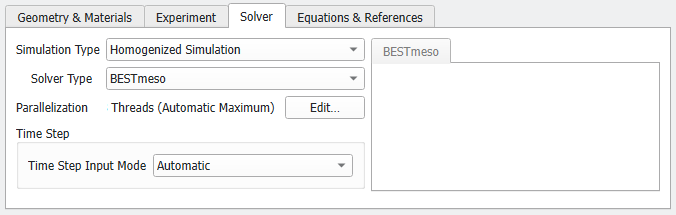

Control how many threads are used for the computation. Parallelization is possible if your license and hardware allow it. The Parallelization Options dialog opens when clicking the Edit button and you can choose between Sequential, Parallel (Shared Memory), or Automatic Maximum of Threads.  Selecting Sequential will not apply parallelization and only one thread is used for the computation. 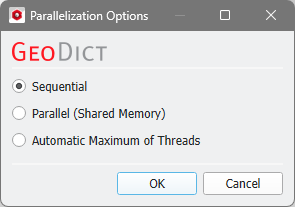 When Parallel (Shared Memory) is selected, the Number of Threads can be entered. Below, the Number of CPU Cores that the current machine has, the maximum number of Licensed Threads and the number of those licensed threads that are available (Available Threads) are shown in the dialog. Of course, the maximal number of parallel processes you can use, is the smallest of those three numbers. 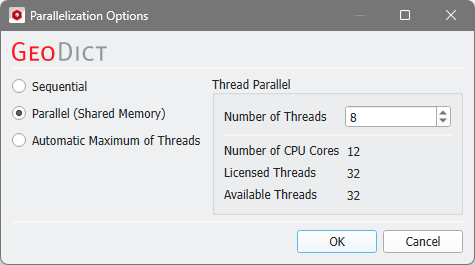 If Automatic Maximum of Threads is selected, the number of parallel processes is automatically selected for optimal speed, based on the CPU cores and licensed parallel processes. 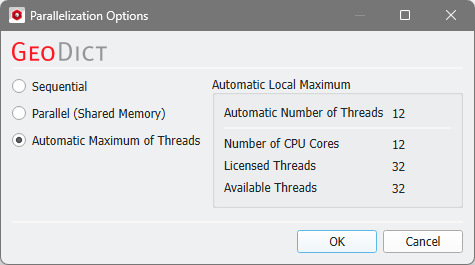 The Automatic Local Maximum of processes is automatically selected, which is the minimum of Number of CPU Cores, Licensed Threads, and Available Threads. |
In the Time Step panel an option for the Time-Step Input Mode may be selected. Any of the electrode solvers calculates the time evolution of the given Li-ion electrode. It starts at the initial state, which has time = 0 in the result plots. It takes the time step defined as maximum time step size and tries to find the electrode state at time = last time + time step by searching an equilibrium solution fulfilling the given system of differential equations. If no solution can be found for this time step size, it reduces the time step size, and the solver starts again. This procedure is repeated until an appropriate time step size is found. This time step size is used for the next steps in the simulation as well. After several successful steps with a certain time step size, the solver tries to increase this time step size again, to reduce overall computation time. With the Time-Step Input Mode, the maximum time-step size can be influenced. For more information on time steps see State of Charge (SOC) and State of Lithiation (SOL).
The time steps that were finally realized in the simulation are saved in the Result Map of the GeoDict result file (*.gdr file), created for the charging simulation, under the key TimeDependentValues:TimeStep. If a new battery state is found in a simulation with a charge rate boundary condition, the solver computes the Electrode-SOC step of the just found new battery state i via: with the time step and the charge rate. So, it is not clear from the start which is the next computed Electrode-SOC in a simulation, this depends on the time step. Example:
If you choose to set the current density instead of the charge rate, then the calculation of the Electrode-SOC step size depends on the given current density and the cell capacity. Thereby, the cell capacity depends on the electrode-geometry and the maximum lithium concentration of the active materials. In the GeoDict result file (*.gdr file) created for the charging simulation, you can find the time-evolution of the Electrode-SOCs in percent as well as the corresponding times in seconds in the Result Map under the keys TimeDependentValues:ElectrodeStateOfCharge and TimeDependentValues:Time, respectively. For simple simulations (charge rate <= 1, physical domain size < = 5 µm, only one active material per electrode, diffusivities >= 1e-12 m²/s, conductivities >= 1 S/m and no warnings during the simulation), the time step size is usually the maximum time step size set. Then, also the Electrode-SOC step is a constant value. However, for more complex simulations (charge rate >= 10, physical domain size >= 50 µm, two active materials in an electrode with different parameters, low diffusivities in the active materials and small conductivities), it might happen that the time step size may be smaller than the maximum time step size defined and not constant over the whole simulation. |
©2026 created by Math2Market GmbH / Imprint / Privacy Policy