Visco-Plasticity
The material laws for plasticity can also be combined with viscosity to achieve visco-plastic material behavior. Three models are available: linear Perzyna, nonlinear Perzyna and Michel-Suquet.
The three models differ in their complexity. The linear Perzyna model is the least complex of the three. It has only one additional parameter (the reference strain rate) compared to time-independent plasticity. In general, one should first try if this model already fits the needs.
The other models should only be considered if the real material shows a behavior which is too complex for the linear Perzyna model. Both have the rate sensitivity parameter, which allows to define how a change in strain rate affects the material behavior. The Michel-Suquet model additionally has the drag stress parameter, which further influences the material behavior and allows to fine-tune the model.
In general, setting up a visco-plastic material law is more complex than setting up time-independent materials. Measuring a stress-strain curve is not enough to explain the behavior of a visco-plastic material. In contrast, more complex experiments are necessary, like, e.g., creep tests, relaxation tests or DMA measurements (Dynamic mechanical analysis).
The different models for visco-plasticity are described by their flow rules. A flow rule defines how the material deforms plastically under a given stress and provides a mathematical expression for the rate at which plastic deformation accumulates. The central parameters in each model are the reference strain rate , which indicates how fast the plastic deformation occurs, and the yield stress , which is updated by the hardening law.
In the following the core formulas of the available plasticity models as well as the corresponding parameters to set up these models in GeoDict are described.
Linear Perzyna Model
The flow rule describes a linear relationship between the overstress and plastic strain rate :
where is the yield stress and the reference strain rate.
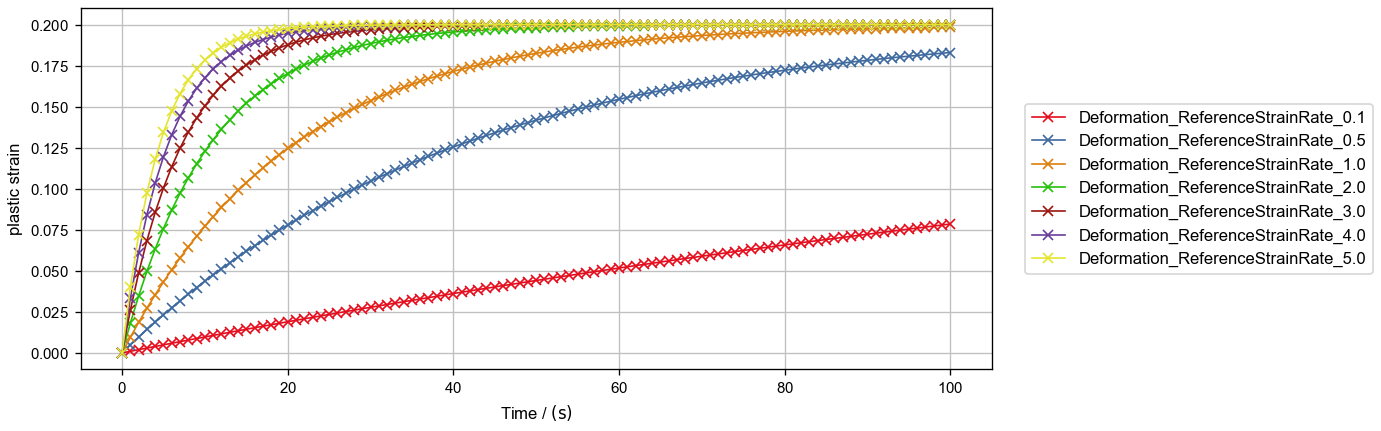
Example: Creep experiment with varying reference strain rates
For this experiment a material was loaded with a constant stress and the plastic strains were monitored for different reference strain rates. In the result plots you can see that with higher reference strain rates the plasticity occurs faster in the material.
Nonlinear Perzyna Model
The flow rule describes a nonlinear relationship between the overstress and plastic strain rate :
where is the yield stress, the reference strain rate and the strain rate sensitivity exponent. For the nonlinear Perzyna Model, the relationship between overstress and plastic strain rate is raised to a power of , where the strain rate sensitivity exponent characterizes the sensitivity of to overstress.
Michel-Suquet Model
In the Michel-Suquet Model an additional stress threshold, , is introduced, allowing a more detailed description of the flow rule.
where is the yield stress, the reference strain rate, the strain rate sensitivity exponent and the drag stress, which controls the rate at which plastic strain accumulates in the material.
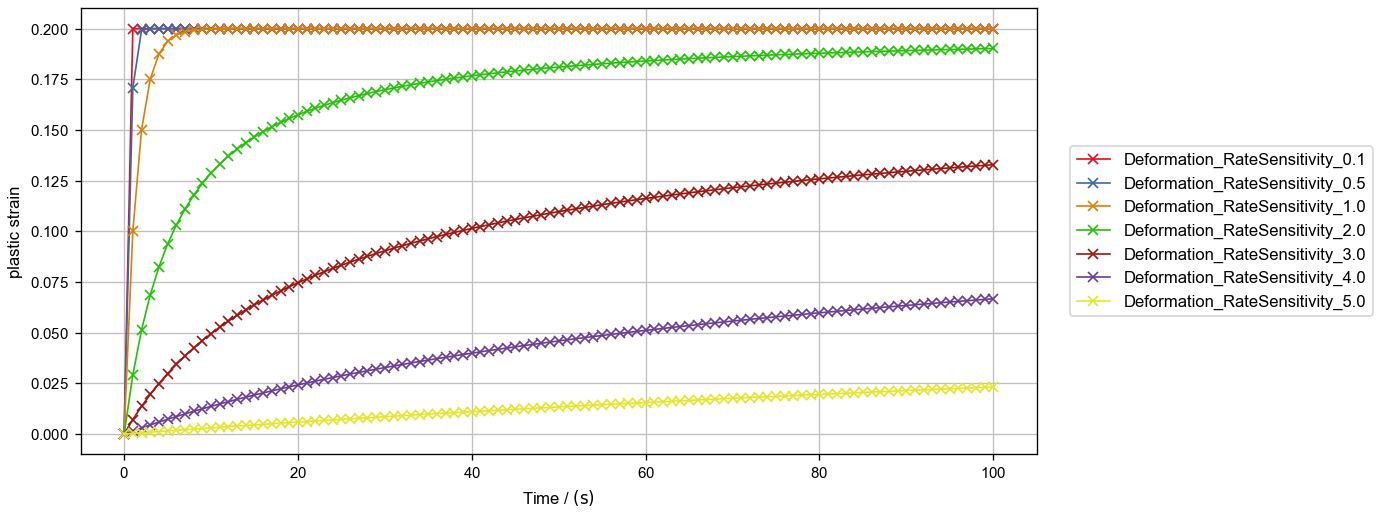
Example: Creep Experiment with varying strain rate sensitivity exponents
For this experiment a material was loaded with a constant stress and the plastic strains were monitored for different rate sensitivity exponents. In the plot of plastic strain over time, you can see how the rate sensitivity exponent affects how quickly plastic deformation develops.
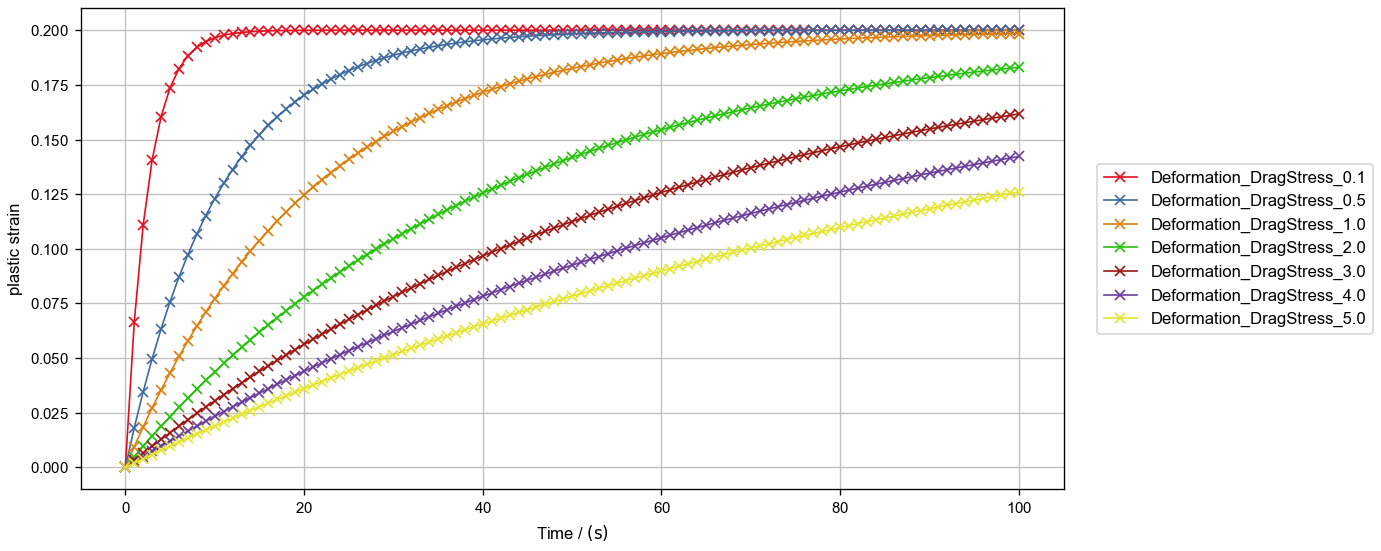
Example: Creep Experiment with varying drag stresses
For this experiment a material was loaded with a constant stress and the plastic strains were monitored for different drag stresses. In the plot of plastic strain over time, you can see that the higher the drag stress, the slower plasticity occurs in the material.