Stopping Criteria
Different stopping criteria for a charging simulation can be defined. Choosing a final state-of-charge for the whole battery or for both electrodes, is the stopping criterion that was available already in previous BatteryDict releases.
If a charging profile is defined, additionally a reached cell potential, charge rate, current density, or current can be defined as stopping criterion. Setting the stopping criterion in the GeoDict GUI is explained for simple charging profiles here and for more complex profiles here.
In the following, as an example, the difference between the stopping criteria final state-of-charge and final cell potential is shown for simulations with constant charge rate.
For simulations with constant charge rate, the time evolution of the cell potential depends on the charge rate selected. The higher the charge rate, the larger the deviation of the cell potential curve from the equilibrium charge curve, since the overpotentials get larger for higher charge rates (see also Overpotentials and Heat Production).
In the following figure, a charging simulation from state-of-charge 20% till 95% is shown for different charge rates using an example structure.
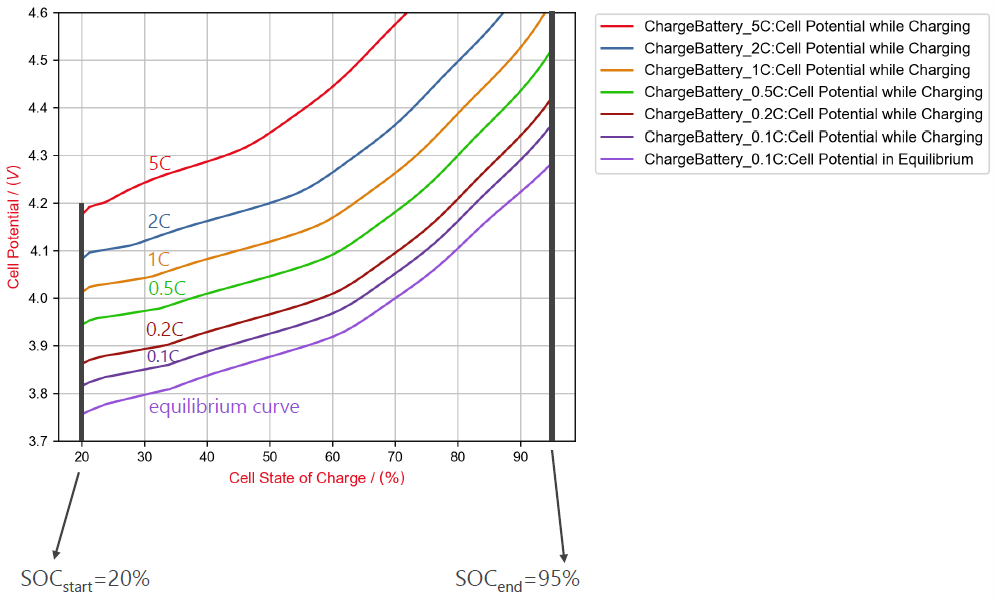
For the stopping criterion final state-of-charge, the computation always runs until the final state-of-charge is reached, here 95%. Depending on the charge rate, the cell potential reached for this final state-of-charge, is very different. Especially for high charge rates, it might not be possible to reach this stopping criterion at all, or the voltages reached may be unphysically high.
On the other hand, if a final potential – here 4.2 V - is defined as stopping criterion, the state-of-charge reached at the end of the simulation will vary depending on the charge rate, while the cell potential remains the same. In the following figure, the reached state-of-charge at the end of the simulation is indicated for simulations with different charge rates. As a result of the varying state-of-charge at the end of the simulation, the capacitance of the battery differs depending on the charge rates.
