Filter Experiment
Under the Filter Experiment tab, choose between a Single Pass or a Multi Pass experiment. For Single Pass, the experiment can be run at a Constant Flow Rate or at a Constant Pressure Drop (often used for membranes). For Multi Pass, choose between the standard test setup or a variant with an initially contaminated test reservoir.
When a method is selected, the setup is shown schematically in the dialog below the pull-down menu. Furthermore, the selected method will influence which options are available elsewhere in the Filter Lifetime dialog.
|
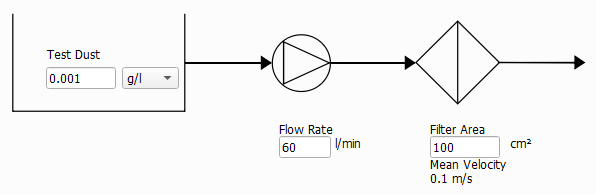
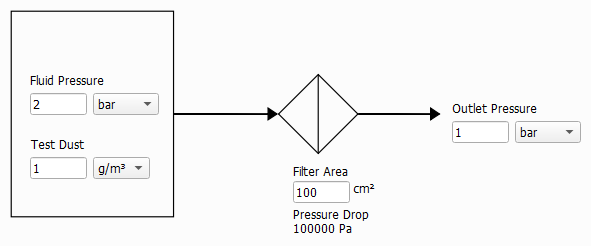
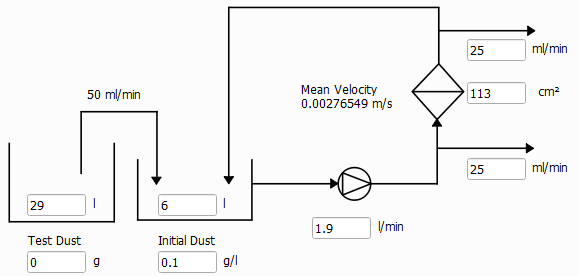
For filter element scale simulations, the meaning of the Filter Area parameter must be clarified. Here, the Filter Area is the rectangular inflow area of the complete filter as illustrated in the figure below, it is not the surface area of the (pleated or otherwise folded) filter medium. The filter area is needed to compute the flow velocity and the number of particles on the part of the structure that is simulated in GeoDict. |

 Single Pass - Constant Flow Rate
Single Pass - Constant Pressure Drop
Multi Pass Test - [ISO 16889] Standard
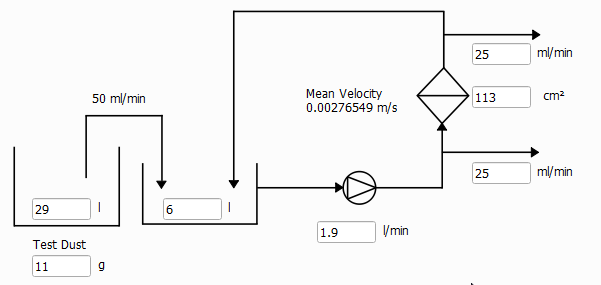
Multi Pass Test - Variant
Simulation Stopping Criterion
The simulation continues to run until one of the following criteria is reached:
- If Max. pressure drop increase is selected, the simulation stops if the initial pressure drop is increased by the given value. This option is not available if Single Pass - Constant Pressure Drop was selected.

- If Max. pressure drop is selected, the simulation stops if the given pressure drop is reached. This option is not available if Single Pass - Constant Pressure Drop was selected.

- If Max. flow rate decay is selected, the simulation stops when the flow rate falls below the given percentage (%) of the initial flow rate. This option is only available if Single Pass - Constant Pressure Drop was selected.

- If Max. time reached is selected, the simulation stops when the defined simulation time is reached.

- If Max. total deposited dust is selected, the simulation stops when the defined amount of deposited dust is reached.

- Multi Pass Test simulations always automatically stop when the Injection reservoir is empty.

- The simulation always automatically stops when the Inflow region is filled with particles. This is triggered when the first deposited particle reaches the inflow plane.

Flow Settings
In FilterDict, the Flow direction and, hence the filtration direction, is always the Z-direction.
The Flow Motion can either be creeping or fast flow. In the creeping flow case, the Stokes equations are solved to determine the flow field. If fast flow is chosen, the Navier-Stokes equations are solved to determine the flow field.
As the Stokes equation is a simplification of the Navier-Stokes equation, choosing Fast flow (Navier-Stokes) will give correct results also in the case of slow, creeping flow. Solving the Navier-Stokes equations is computationally more expensive than solving the Stokes equations, so it is advisable to choose Creeping flow (Stokes) whenever justified.
For Creeping flow (Stokes), Periodic, and Velocity in - Pressure out (VinPout) can be chosen as Boundary Condition in flow direction. VinPout cannot be chosen for a Single Pass – Constant Pressure Drop experiment.
For Fast Flow (Navier-Stokes), the boundary conditions in flow direction are set to Velocity in, Pressure out (VinPout) if Constant Flow Rate was chosen under the Filter Experiment tab, and set to Periodic if Constant Pressure Drop was chosen under the Filter Experiment tab.
In Tangential Directions, Periodic or Symmetric boundary conditions can be selected. For more information about the flow computation, please refer to the FlowDict handbook of this User Guide.
The choices made for the flow boundary conditions in tangential directions also determine what happens when a particle reaches the domain boundary in one of the tangential directions. With Periodic boundary conditions, the particle will leave the domain and reappear on the opposite site. With Symmetric boundary conditions, a particle will be reflected at the domain boundary.
The Slip Length allows to include sliding effects in the flow simulation. Typically, the slip length is of the same order of magnitude as the mean free path of the fluid (which is e.g. 68 nm for air at ambient conditions) and can be neglected if this is much smaller than the voxel length, which is typically the case for simulations on the filter element scale. A value of 0 corresponds to no-slip boundary conditions.
