Constituent Materials
On the top of this tab, select if the Particle Resolution is Resolved or Unresolved.

Choose Resolved if all particles are larger than the current voxel length, and Unresolved if some particles are smaller than the current voxel length. For further explanation, see the Filter Clogging page.
Define Temperature and Fluid Density/Viscosity as described for the Constituent Materials tab of the Filter Efficiency command.
Permeability
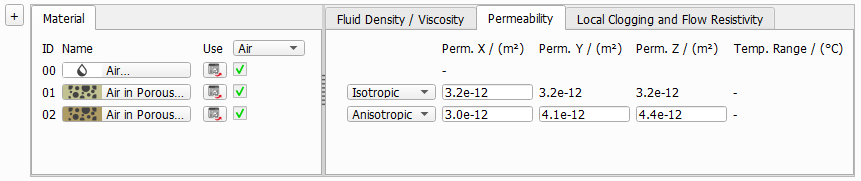
For all porous materials, the flow permeability must be set here. It can either be Isotropic or Anisotropic, in which case the permeabilities in the three space directions X,Y,Z can be entered.
|
Know how! The anisotropic permeability is always aligned with the coordinate system, not with the orientation of the filter media. Therefore, it is often the best choice to select Isotropic and use the through-plane permeability of the flat sheet material, as this is the permeability most relevant to the flow direction. |

Local Clogging and Flow Resistivity
If the unresolved particle model is chosen, the Local Clogging and Flow Resistivity tab becomes additionally available.
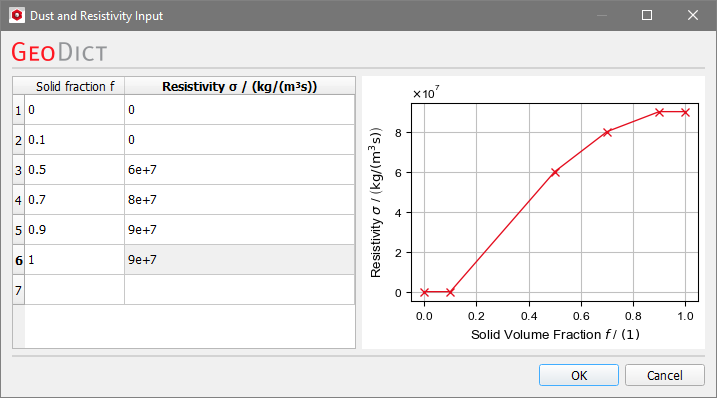
Unresolved particles will create porous voxels when deposited into the 3D structure. In those voxels, flow is still possible, but experiences an increased flow resistivity. In the Local Clogging and Flow Resistivity tab, the relation between the dust volume fraction inside of a voxel and the flow resistivity must be defined. This tab is only available for unresolved simulations, because in the Resolved case all voxels are treated as either empty or solid.
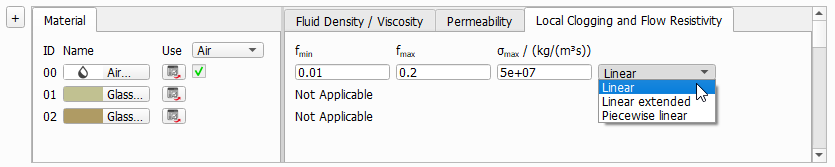
The flow resistivity depends on the values for , and , which must be defined for every material of the structure which can be filled by dust particles during the simulation, i.e. inside of the fluid (where the filter cake will form) and in all porous layers.
|
Note! It is necessary to set these parameters for the fluid material, although this might be unintuitive at first glance. Be aware that the parameters set for the fluid material describe the behavior of the filter cake because the filter cake consists of partially dust-filled voxels of the fluid domain. |

|
Note! It is not possible to use different fluids in a structure, but it is possible to use different material IDs with the same fluid. This option is useful, when the filter cake should have different properties depending on its location in the structure. |
Three different models are available to define the function : Linear, Linear extended and Piecewise linear.
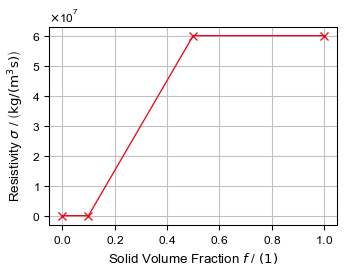
 Linear Extended
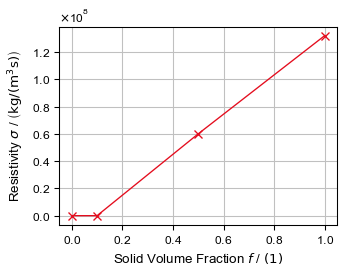
|
Know how! You can upscale the results of a fully resolved filter media simulation to determine these input parameters. In the Report tab of a Filter Media - Filter Lifetime command, the Filter Clogging Analysis computes parameters that can be used as input here. Use the reported Cake Filtration values as and of the fluid phase and the reported Depth Filtration values as and of the porous filter material. |
