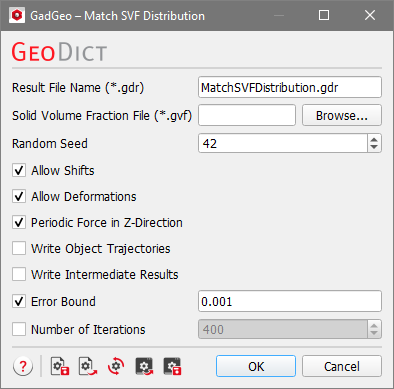
The Match Solid Volume Fraction (SVF) Distribution command allows to create structures with an inhomogeneous solid volume distribution. A specialized form of this algorithm is also available in FiberGeo and GrainGeo, where a Gaussian random field is created and used directly in the generation step to achieve an inhomogeneous distribution. Here, the algorithm can be used in a more general way.
Required input is a generated structure with GAD object information and periodic domain, and an arbitrary solid volume fraction distribution, defined through a GeoDict Volume Fraction (.gvf) input file. Such a file is created in FiberGeo or GrainGeo when the Match Solid Volume Fraction (SVF) Distribution was chosen. It can also be created using the Create Gaussian Random Field command available from the context menu of the Volume Files entry (this feature is only available if FiberGeo or GrainGeo is licensed).
Alternatively, use 3D Inhomogeneity in MatDict to create a distribution based on a CT-scan or a mask structure (see example) or use the GeoPython library or other tools to create a file with the desired input values yourself.
Clicking the Options’ Edit… button opens the Match SVF Distribution dialog where additional parameters can be entered.
Click Browse… to search for the .gvf file here. The chosen file must match to the current structure in the sense that the domain size (in physical length, not in the number of voxels) must be the same.
The absolute SVF values in the file are not important, as the distribution in the file is scaled to match the mean solid volume fraction of the loaded structure. The solid volume fraction file should have a coarser resolution as the structure file, otherwise the computation time will become large. For many cases a 10 times coarser resolution works well, meaning it has a voxel length of 10 µm when the original structure has a voxel length 1 µm.
The algorithm tries to achieve the given SVF distribution by modifying the GAD objects. This is done in a random order and the given random seed determines the order. Thus, different random seeds will lead to different results.
If checked, the objects will be deformed to achieve the desired SVF distribution. This applies only to objects that can be deformed at all. For example, fibers can be deformed, but not spherical grains.
If checked, the force is periodic in all three directions, which is recommended for most cases.
If unchecked, the force is periodic in X- and Y-direction, but not in Z-direction. In that case, the objects are repelled from the domain boundary in Z-direction. This requires that some empty space be available at the top and bottom of the structure.
In each step, the objects are shifted and deformed by a certain value and the difference to the desired solid volume fraction is computed. Afterwards, the new difference is used to do the next iteration. This enables to compute how much the SVF has changed in the last iteration and define a certain value for which the simulation should be stopped. This is the recommended stopping criterion.