Particle Tracking
AddiDict simulates how particles and molecules move through your structure. The movement of particles in the fluid is influenced by the following factors:
 |
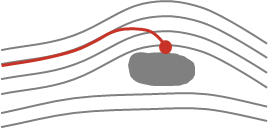
Drag forces are the dominant forces in most cases, and particle trajectories are close to the streamlines of the flow field |
 |
Electrostatic effects. The particles and pore surface can be electrostatically charged. This leads to attraction or repulsion effects. |
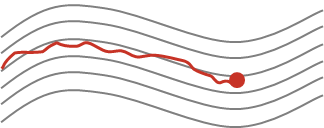 |
Diffusive (or Brownian) motion. Particle collisions with fluid molecules lead to small random direction changes. |
AddiDict simulates the particle movement by considering these three effects. Electrostatic attraction and/or diffusive motion can be switched off if is known a-priori that these effects have no influence on the mas transport process. Overall, the particle movement is governed by
Particle Momentum = Stokes Drag + External Forces
or, as formula:
In the friction coefficient
the particle radius is optionally corrected by the Cunningham correction factor,
to account for the reduced drag of very tiny particles that may easily pass between the molecules of the surrounding fluid. The particle diffusivity computes Brownian motion through
You might disable the simulation of Brownian motion. In that case the diffusivity is set to zero. External forces are the electrostatic force and an additional force field which is
by default. When you disable electrostatic effects, the electrostatic field is set to zero.
Equations (92) , (93) , (94) , and (95) can be changed through user defined functions, e.g., to include gravity or buoyancy forces in .
The used variables and their units are:
Symbol |
Unit |
Meaning |
|
Symbol |
Unit |
Meaning |
m/s |
particle velocity |
C |
particle charge |
|||
m/s |
fluid velocity |
V/m |
electric field |
|||
kg/s |
friction coefficient |
J/K |
Boltzmann constant |
|||
kg/m·s |
dynamic viscosity |
3D Wiener measure |
||||
m |
particle radius |
K |
temperature |
|||
1 |
Cunningham correction factor |
m²/s |
diffusivity |
|||
kg |
particle mass |
N |
external force |
|||
m |
mean free path |
The electrostatic charges are assumed as constant given forces on the solid surface. A constant charge density is assigned on all voxel walls. The electric field
is determined by solving the Poisson equation for the potential (unit:V)
where is the surface charge density (unit: C/m²) and = 8.854188E-12 F/m is the permittivity. Here, denotes the solid surface and is the Dirac distribution.
Here, is periodic in the tangential directions and should satisfy zero Dirichlet boundary conditions at and in flow direction. Numerically, infinity is replaced by and in the z-direction.
By construction, these boundaries lay away from the solid material and there is no conflict between singular forces on solid surfaces and these Dirichlet conditions. Due to the periodic boundary conditions, the potential feels a non-integrable amount of charges and tends to infinity in the solid material as the Dirichlet boundary is moved away from the solid.
Thus, the potential depends on the position where the Dirichlet condition is located. However, only the electric field is needed to determine the movement of the particles in equation (91) and this remains almost unchanged from the location of the Dirichlet boundary as soon as this boundary is sufficiently far away from the solid material.
Cunningham Correction and Molecular Mean Free Path
In fluid dynamics, the momentum equations for Newtonian fluids are the Navier-Stokes equations and the Stokes equations in the case of low Reynold’s numbers. These equations rely on the continuum assumption for the fluid, i.e., the fluids are sufficiently dense to be a continuum, do not contain ionized species, and have flow velocities that are small in relation to the speed of light. For the movement of very small particles through a fluid this assumption is not valid anymore. In consequence, the no-slip condition at the particle – fluid interface does not hold anymore and, so, the drag force acting on a particle moving through a fluid has to be corrected for this effect.
The Cunningham correction factor allows predicting the drag force on a particle moving within a fluid with properties between the continuum regime and free molecular flow. The fluid properties are defined by the dimensionless Knudsen number (), representing the ratio of the molecular mean free path length ( [m]) to a representative physical length scale ( [m]):
A typical choice for the representative physical length scale is the pore size of a structure. Different regimes for micro/nano flow fields are distinguished based on the following critical Knudsen numbers:
- 0 < Kn < 10-2 for continuum flow regime.
- 10-2 < Kn < 10-1 for slip flow regime.
- 10-1 < Kn < 10 for transition.
- 10 < Kn for free molecular flow regime.
Mean free path lengths in liquid water are reported to be in the order of 3.0⋅10-10 m (temperature of 20°C and pressure of 1 bar) and so Knudsen numbers of above 10-2 are reached for pores with radii smaller than 3.0⋅10-8 m. For air at ambient conditions, the mean free path length is reported with 68 nm and so Knudsen numbers of above 10-2 are reached for pores with radii smaller than 6.8⋅10-6 m. Hence the Cunningham correction will only be relevant for gas flows. The Cunningham correction factor () is defined as follows:
where is the molecular mean free path length [m], is the particle radius [m] and are experimentally determined coefficients.
Particle Displacement and Travel Distance
Displacement and travel distance describe two different aspects of a particle's motion.
Displacement is defined as the straight-line distance between a particle's initial position and final position. It depends only on these two points, regardless of the path taken between them.
Travel distance represents the total length of the path the particle follows during its motion. When Brownian Motion influences a particle's movement, it may travel along a highly irregular path. This causes the travel distance to be significantly greater than the displacement.
Molecular Limit
AddiDict can also be used to model the movement of molecules. For molecules, the particle radius is unknown, and the particle momentum equation cannot be used directly to compute the movement of molecular particles. However, when considering the limit for in the particle momentum equation, one observes that the particle mass m is of order , and therefore the left-hand side disappears.
Thus, in case that no electrostatic or external forces are present, the equation simplifies to:
such that the particle velocity equals the flow velocity plus a random movement. In that case, only the diffusivity of the molecule is needed as input.