Interaction Model
Under the Interaction Model subtab, properties of the particles as well as their interaction with the solid and porous materials, available in the structure, are defined. The choice of parameters under this subtab affects the entries and columns shown in the table under the Size Distribution subtab.
Pass Through and Collision Models
For all materials in the model, a Pass Through Model and a Collision Model must be defined. It depends on the choice of the Pass Through Model whether a Bounce Model needs to be selected as well.
Solid materials are always Impassable for particles, and for them, one of the collision models Caught on first touch, Hamaker, Sieving and Random can be chosen. The Hamaker model can only be selected for particles with finite size diameter, while Random can only be chosen for molecules. Additional columns appear in the table under the Size Distribution subtab when Hamaker (columns Restitution and Adhesion), Sieving (column Restitution), or Random (column Deposition Probability) are chosen as Collision Model.
Additional collision models can be defined by the user in user defined functions (UDF) and accessed by adding an UDF Search Folder by clicking the file button at the top right of this tab. UDFs are more commonly used for filter simulations. Thus, more details can be found in the FilterDict user guide.
For porous materials, one of three Pass Through Models can be selected:
- When set to All particles pass, particles can move through the material. In that case, no Collision Model can be selected.
- Choosing Impassable sets the material to be treated as a solid material and particles cannot enter.
- When Bounce Probability is selected, part of the particles can enter the porous material, while others collide with the material. Here the expected behavior of a fully resolved porous materials is simulated. The part of the particles that enter the material are the particles that hit the porous material at a pore. The part of the particles that collide with the material are the particles that hit the solid. This option should only be chosen if the particles are smaller than the pore sizes of the porous material, i.e., they can enter the material. The percentage of the particles that enter the material, depends on the choice of the Bounce Model.
Bounce Models
For the Bounce Model three different options are available:
- Select Manual to define the probability of a particle to be reflected at the interface between pore space and porous material by clicking the Edit button. In the example shown, the probability of a particle to be reflected, if it reaches the interface between the pore space (ID 00) and the porous material (ID 02), is 20%. Vice versa the probability that the particle enters the porous material is 80%.
- For Connected Porosity, the bounce probability depends on the porosity of the material the particle is entering (porosityto) and the material the particle is leaving (porosityfrom). The reflection probability is porosityfrom - porosityto / porosityfrom.
If the particle is moving from a region with low porosity to one with higher porosity, it will never be reflected, i.e., the reflection probability is always kept between 0% and 100%. This Bounce Model should be selected when you have materials with different porosities, i.e., pores that are connected and change only their width at the interface between materials. The porosity value(s) of the porous material(s) need to be set correctly on the Constituent Materials tab. - If Independent Porosity is selected, the reflection probability is 1 - porosityto, i.e., if the porous material has a porosity of 30%, 30% of the particles reaching the interface enter the porous material and 70% are reflected. The porosity value(s) of the porous material(s) need to be set correctly on the tab Constituent Materials.
In the example shown here, with only an interface between pore and porous material, Connected and Independent Porosity both give the same value. Clicking the Edit button shows the computed value.
Particle Diameter
For the Particle Diameter two options are available. If Finite Size is set for the Particle Diameter, the momentum equation is solved to model the particle movement. For Molecules (Limit d=0) the simplified movement equation is solved. In this case, no Particle Density value has to be entered, Particle Charges are set to zero (i.e., the subtab Electrostatic Effects becomes inactive), and Diffusivities have to be defined individually per particle type in the Size Distribution subtab.
Particle Density
For finite sized particles, a Particle Density has to be entered. If Constant is chosen, one density is set for all particle sizes. If Individual per particle type densities are chosen, the field to set the Density disappears and individual density values have to be entered in the Size Distribution subtab.
Particle Diffusivity
For Particle Diffusivity, you can choose between Brownian Motion and Individual per particle type. For Brownian motion, the diffusivity coefficient is computed following the equation described in the theoretical background. For Individual per particle type, the value of D must be entered under the Size Distribution subtab for each particle type. The values entered in the Diffusivity in Pore column are used to model the diffusion of the particles in the pores and the values entered in a Diffusivity in Media column are used to model the diffusion inside of porous materials. In the table, one column appears for each porous material which allows particles to pass, i.e., for which the Pass Through Model is set to All particles pass or to Bounce Probability.
Particle Sliding
Particles that collide with the surface loose some of their energy if the restitution factor is smaller than 1. In certain pore geometries, the flow may move a particle very close to a pore surface. This causes many consecutive hits, and repeatedly applying the restitution factor will stop the particle's motion. This behavior is often undesired, and it may overestimate the filter efficiency when combining a Sieving collision model with a relatively low restitution value.
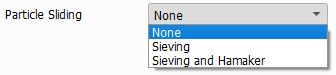
When Sieving is selected in the drop-down menu, all Sieving particle-wall collisions are modified, when Sieving and Hamaker is selected, all Sieving particle-wall collisions are modified and all Hamaker particle-wall collisions are modified. Caught on First Touch particle-wall collisions are not modified.
Enabling Particle Sliding for the Sieving or Hamaker collision models enlarges the tangential restitution factor when a particle hits a surface in a location that lies close to the last surface collision.
The first bounce on the wall is always treated the same, independent whether particle sliding is active or not: A particle arrives with a certain velocity, loses energy on impact, and bounces back again. The strength of the bounce-back is controlled with the given Restitution. When particle sliding is active, further impacts near the first hit are treated differently: Only the momentum perpendicular to the wall is reduced. The velocity along the wall is not reduced further, so in this direction the restitution is equal to 1. This means that particle movement along the wall is no longer slowed down. The normal restitution remains unchanged. In effect, the particle will slide along the surface.
Without particle sliding:
|
With particle sliding
|
In setups where particles are sieved by filter materials having pores of well-defined sizes (e.g., in meshes, nets or weaves), selecting particle sliding has a great influence on the computed filter efficiency and pressure drop and it is recommended to select this option.
In setups where particles are mainly caught by adhesion or where the filter material consists of irregular pores of many different sizes (e.g., nonwovens), the choice of the particle sliding model has little to no effect on the simulation results.