|
Navigation: GeoDict 2026 - User Guide > Material Modeling > FiberGeo > Create Fibers > Options > Create Options |
Scroll |
Domain
The Domain panel contains the parameters defining the structure size (NX, NY, and NZ) in combination with the resolution (Voxel Length), as well as the Origin parameters, the Periodicity check boxes, the Center Domain button, and the Pore / Matrix Material button.
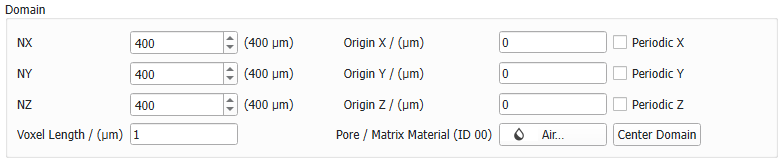
The internal representation of a structure in GeoDict consists of rectangular 3D arrays of cubes, hereafter called volume elements or voxels. NX, NY, and NZ are the number (N) of voxels in X, Y, and Z directions. The Voxel Length is the size of one voxel in the chosen units. Varying the values for NX, NY, and NZ has the effect of changing the size of the structure in the given direction. Low values for Voxel Length in combination with high values for NX, NY, and NZ increase the resolution, but also increase computational time. After setting the values of NX, NY, NZ, and Voxel Length, the physical structure size is automatically displayed in the chosen units (here µm). The following example shows how starting with NX = 200, NY = 200, NZ = 200 (100 x 100 x 100 µm3, at voxel length 0.5 µm), and decreasing the Voxel Length from 0.5 µm to 0.25 µm has the effect of refining the structure by increasing the resolution, while decreasing the size of the volume to 50 x 50 x 50 µm3. By setting NX = 400, NY = 400, NZ = 400, to restore the size of the volume to the original 100 x 100 x 100 µm3, the structure is displayed at higher resolution. |
 Origin X, Origin Y, and Origin Z
The Origin X, Origin Y, and Origin Z parameters, together with the Center Domain button, determine the placement of the structure in the physical space. Zero values for Origin X, Origin Y, and Origin Z mean that the point with (0, 0, 0) coordinates is located at the lower left corner of the structure.  When clicking the Center Domain button, the (0, 0, 0)-point is set to the center of the structure as shown below.  |
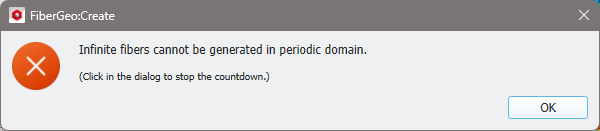
Checking the Periodic X, Periodic Y, and Periodic Z boxes allows the generation of structures which are periodic in one or several directions. Periodicity has the effect, that objects ending on one side of the volume reappear on the opposite side, so that attaching of several volumes with periodic objects results in a repetitive complex.
Checking the Periodic X and Periodic Y boxes, but leaving un-checked the Periodic Z box, has the following effect on the periodicity of a generated fibrous structure. This effect can be observed more closely, when processing the sample structure through Model → ProcessGeo (Repeat: X- 400 voxels, Y- 400 voxels, and Z- 400 voxels) and viewing it again from the three directions. In the directions checked as periodic (X and Y), the fibers connect to each other across the repeated samples. In the direction checked as non-periodic (Z), the fibers end at the edge of the sample.
|

Pore / Matrix Material and Density
Choose the material of the pore space or the matrix around the fibers from the pull-down menu. When the material is chosen to be Pore, the fibers are embedded in empty pore space. Otherwise, the material filling the matrix can be chosen to be a Solid, Porous medium, or Fluid in which the fibers are embedded. Control color and visibility of the the different Material IDs through the Color & Visibility tab of the side bar on the right of the GeoDict GUI. |
©2026 created by Math2Market GmbH / Imprint / Privacy Policy