Kelvin Structure
Kelvin Structures are regular foams based on the bitruncated cubic honeycomb (or tessellation) by which space is partitioned into cells of equal volume. Kelvin structures are made up of 4 truncated octahedra around each vertex. Being composed entirely of truncated octahedra, it is cell-transitive. It is also edge-transitive, with 2 hexagons and one square on each edge, and vertex-transitive. It is one of 28 uniform honeycombs.
The FoamGeo - Kelvin Structure dialog box for the generation of Kelvin structures opens by clicking the Edit… button. It contains the Unit Cell, Foam Options, and Output tabs. The available units (m, cm, mm, µm, nm, and Inch) are selectable from the pull-down menu on the top right.
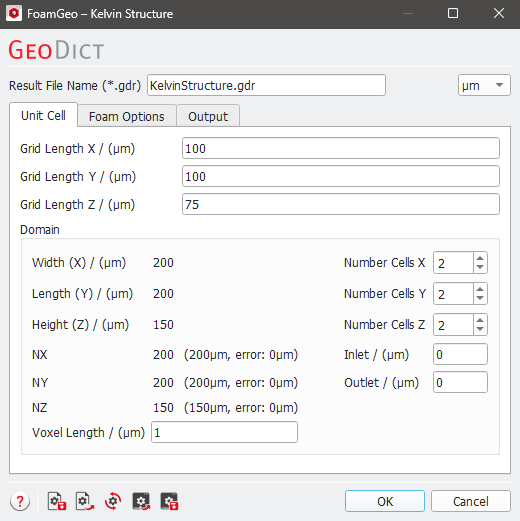
A customized Result File Name (*.gdr) can be entered to differentiate the results of different FoamGeo runs. The *.gdr result file created during the generation is automatically saved to the chosen project folder.
Learn how to generate a Kelvin Structure: |
|---|
|