Air Permeability Test
Air Permeability is an important factor in the performance of textile materials, e.g., gas filters or fabrics for air bags.
|
Modules needed to run this GeoApp: FlowDict |

|
Know how! The air permeability is the air volume that passes through the media per time and surface area. It therefore has the unit cm³/min/cm² or ft³/min/ft² and thus describes an average flow velocity through the media at a standardized pressure drop. It is not to be confused with the material property permeability that is used in Darcy's law which has the unit m² or Darcy. |

Select Air Permeability Test from the pull-down menu and click the Option’s Edit… button to open a dialog to enter or edit the simulation options. Choose a Result File Name for the result file (*.gdr) fitting to your current project.
Input Mode
Two different Input Mode are available to prescribe the pressure drop for the simulation. Either enter a pressure drop manually or select one of the norms that define a pressure drop for the measurement. The pressure drop is applied in Z-direction on the current 3D structure.
Computation Method: Direct Simulation
If you select Direct Simulation as Computation Method, the Navier-Stokes command is used to simulate the air flow at the prescribed pressure drop. The boundary conditions and all solver parameters are automatically selected by the app.
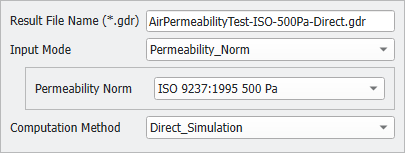
You can find the computed air permeability in the first line of the report.
Computation Method: Forchheimer Approximation
If the media has a low flow resistivity, the air velocities may become very high at the prescribed pressure drop. In some cases, the flow might become turbulent, and the Direct Simulation might not converge. In these situations, select Forchheimer Approximation as Computation Method.
Select two lower pressure drops (Pressure Drop 1 and Pressure Drop 2), which will be used for the extrapolation. The first value can be very small, but the second can be selected as high as possible (but low enough that convergence of the solver is still achieved).
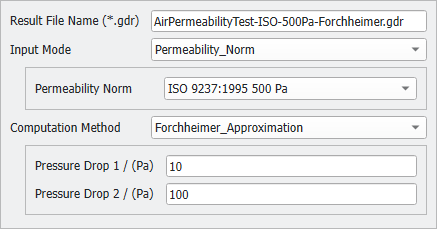
The app uses the Navier-Stokes command to simulate the air flow at the prescribed pressure drops. The boundary conditions and all solver parameters are automatically selected by the app. Afterwards, the app uses the Forchheimer Approximation command to estimate the air permeability. You can find the result at the bottom of the report. Note, that the air permeability is reported as velocity in m/s here.