Forchheimer Approximation
The Forchheimer Approximation command allows to estimate pressure drop and mean velocities for high Reynolds numbers from measured or simulated results for small Reynolds numbers.
At high Reynolds numbers, the flow becomes turbulent and no stationary solution exists. In this situation, FlowDict cannot compute a stationary solution and the Navier-Stokes solver will diverge or oscillate. Nevertheless, flow simulation results achieved for smaller Reynolds numbers, i.e., at lower flow velocities, can be used to predict the outcome at higher velocities. It is also possible to change the fluid properties, i.e., viscosity and density, and estimate pressure drop or mean velocities for other fluids with lower viscisities. In short, the formula allows to extrapolate the results of higher Reynolds numbers.
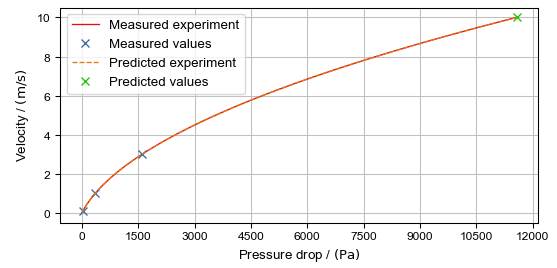
Forchheimer’s equation describes the pressure drop of a fluid flow (in a porous media). The equation extends Darcy’s law and considers the pressure drop caused by turbulence in addition to the pressure drop caused by dynamic viscosity:
where (m/s) is the fluid flow velocity, (m2) is the permeability, (Pa ∙ s) is the dynamic viscosity, (Pa) is the pressure, and (kg/m3) is the density. The new symbol (m) is the non-Darcy permeability coefficient and depends on the porous media only. It does not depend on the flowing fluid.