Connecting GrainFind analysis results with GrainGeo
Use the results of an Identify Grains run in GrainGeo to create a “digital twin” of the material, which is a structure with similar properties.
Start GrainGeo by selecting Model → GrainGeo in the menu bar and choose Create Grains from the pull-down menu. Click the Edit… button. In the upper right of the GrainGeo Create Options dialog, click Load GrainFind Result… and select a GeoDict result file (*.gdr) from a GrainFind run.
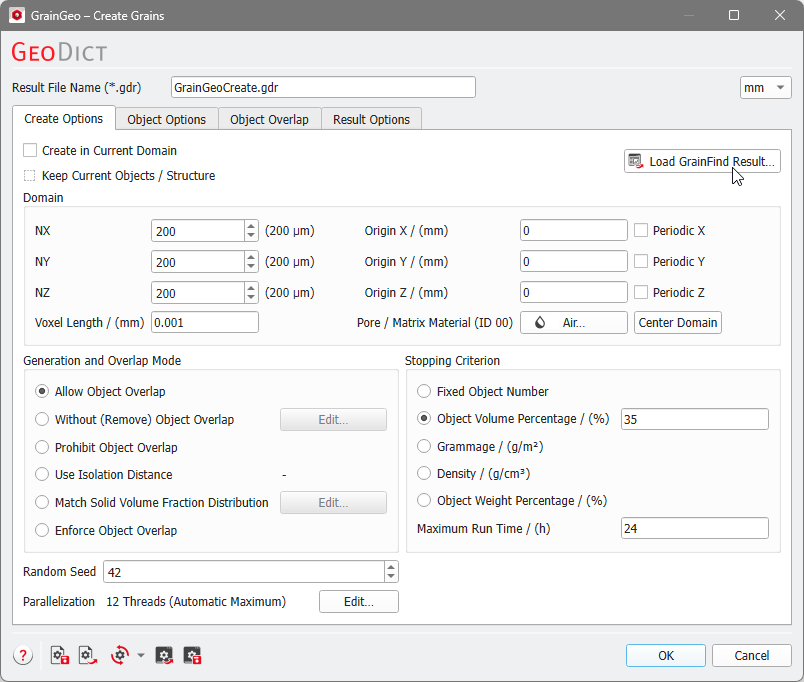
The data from the *.gdr file is now directly loaded into the GrainGeo dialog. In the figures below, the parameters directly imported from the GrainFind result are displayed under the Create Options tab and the Object Options tab in the GrainGeo Create Options dialog.
The GrainFind results are automatically entered in the Domain parameters, the Generation and Overlap Mode (Overlap SVP in the options of Without (Remove) Object Overlap), and in the Object Volume Percentage of the structure under the Create Options tab.
|
Know how! In the Domain panel, the Periodicity in all directions is automatically selected, even if the original structure was not periodic. This is done, because the Remove Overlap algorithm works best with periodic domains. |

The identification analysis also automatically delivers the Material of the identified objects (for example, Calcite), the Diameter size and the Orientation parameters of the grains under the Object Options tab.
Click Generate in the GrainGeo section to generate a structure with the parameters obtained from GrainFind with GrainGeo. In the example below, on the left side the original structure (this structure is analyzed with GrainFind) and on the right side a structure based on the GrainFind parameters are shown.
|
Example: Digital Twin of a 3D-Scan With GrainFind and GrainGeo you can also create digital twins of large segmented scans, like the NMC cathode structure provided by the ETH Zurich published by Ebner et. al., which can be seen below. For more details, please have a look at our tutorial “Building a statistical Digital Twin of a cathode”. |