PoroDict
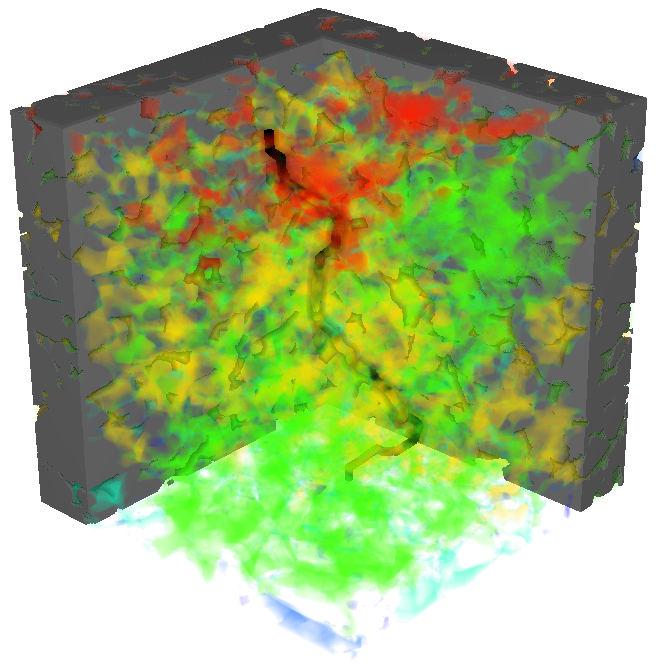
PoroDict estimates the pore structure characteristics of three-dimensional models of porous media obtained from a µCT or FIB/SEM image or from a 3D model generated with GeoDict.
Learn to use PoroDict
|
- Theoretical Background
Learn how pore size can be measured using the different commands of PoroDict.
- Pore Size Distribution (Granulometry)
Determine the pore radius by fitting spheres into the pore volume.
- Pore Size Distribution (Porosimetry)
Porosimetry measures the pore sizes by pressing a non-wetting fluid into the medium. The pressure applied is related to the radius of the pores.
- Identify Pores
This method introduces a segmentation of the pores, based on a distance transform, which allows a detailed pore-size characterization.
- Open and Closed Porosity
Determination of Open Porosity (pores connected to a domain boundary) and Closed Porosity (pores not connected to a domain boundary).
- Bubble Point
Compute the Bubble point pressure, which is a direct measure of the effective pore diameter.
- Percolation Path
Check if there is a percolation path for a specified material in the structure and determine its length and minimal diameter.
- Chord Length Distribution
Determine the distribution of the length of a typical chord (number of connected voxels along the computational direction) of a structure.
- Geodesic Tortuosity
Find the shortest paths crossing the material, either through pore space or through solid materials.
- Pore Analysis GeoApps
The Pore Analysis GeoApps section contains additional Python macros deployed with GeoDict for specific applications.
- References
Publications cited in this chapter.
|