Upscaling Mercury Injection Capillary Pressure
The Upscaling MICP GeoApp is a comprehensive solution for analyzing complex porous media, effectively bridging the gap between small-scale, detailed experiments and large-scale, practical applications. This capability is essential for improving the precision of simulations, enhancing material performance predictions, and making informed decisions in various industrial and research contexts.
This GeoApp computes the MICP on structures with unresolved porous materials. For those materials, no exact fluid distribution can be calculated as the location of the pores is unknown. However, you can determine or measure the capillary pressure curve of the porous material at a higher scale and use this information for the computations in the GeoApp.
|
Important! The structure you want to analyze must contain at least one porous material phase. |

|
Modules needed to run this GeoApp: SatuDict, GeoApp-Upscaling MICP |
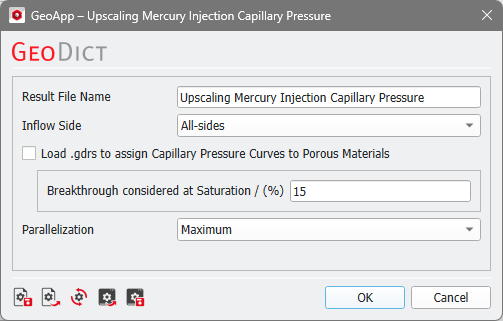
At the top of the dialog, enter the Result File Name. The result file is saved in the chosen project folder (File → Choose Project Folder in the menu bar).
Below, choose from which domain sides the mercury may intrude the structure. Either All-sides can be chosen, or one specific domain side (e.g., z+) is available.
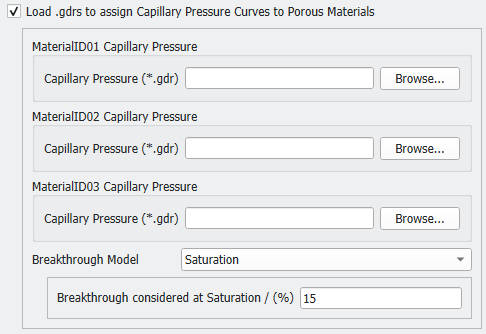
Next, you have to define from which source the capillary pressure curve values are taken.
 Load .gdrs to assign Capillary Pressure Curves to Porous Materials
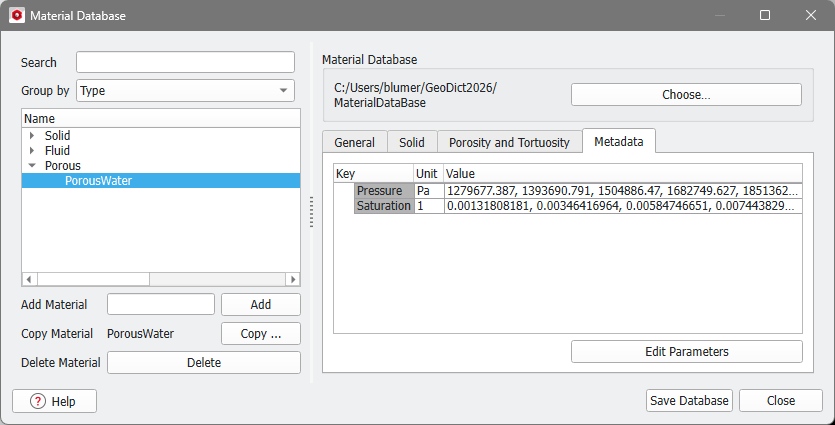
Define capillary pressure values in the material properties
For the Parallelization of the execution either use the Maximum number of cores or enter a Manual value.
Results
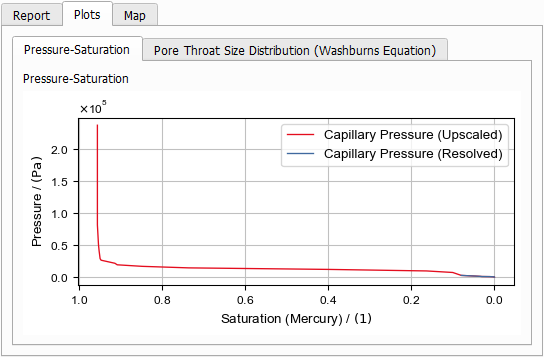
The result file shows the capillary pressure curve, where the resolved part, which could be calculated with the Mercury Porosimetry & Capillary Pressure command, and the upscaled (unresolved) part are marked.
|
Note! No residual is left in the structure, except the closed pores, which cannot be filled with mercury as they are not connected to any inflow side. Thus, the mercury saturation is not exactly 100%. |

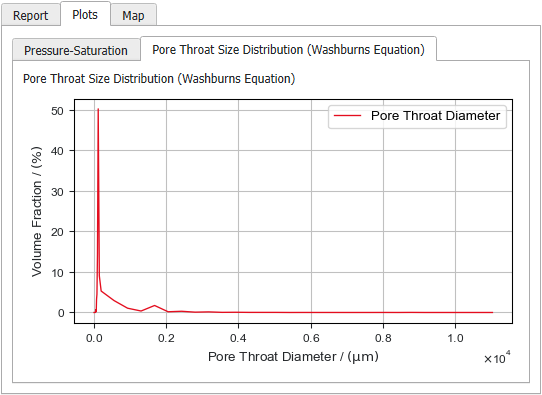
Additionally, the pore throat size distribution calculated with the Washburn equation is given as in the result file of the MICP command.