Constituent Materials
Under this tab, the constituent materials of the pore space/matrix and the structure material(s) can be chosen from the GeoDict Material Database or set by the users.
The parameters for Constitute Materials are divided into Electrical Conductivity, Specific Electrical Contact Resistivity, and Porosity / Tortuosity.
 Electrical Conductivity
The electrical conductivity for each of the constituent materials needs to be specified for Compute Electrical Conductivity. More information on constituent materials can be found in the Material Database chapter.
For every material, one of the material laws defined in the material database must be selected. For Manual defined materials, Isotropic, Transverse Isotropic or Orthotropic conductivity can be chosen from the pull-down menus. When Transverse Isotropic or Orthotropic is chosen, the EJ solver cannot be selected in the Solver tab, and the LIR becomes the only choice of the solver.
|
Specific Electrical Contact Resistivity
When contact resistances exist between different materials, enter the parameters in the Specific Electrical Contact Resistivity sub-tab.
First, choose the Number of Specific Contact Resistivities. This creates the desired number of rows in the input tab. There, select the materials for Material ID 1 and Material ID 2, and set the value of the specific thermal contact resistivity between these two materials.
If the contact resistivity between the two materials has a finite value, then Finite resistivity should be chosen as the Contact Type. The contact can also be an insulator, which means the resistivity is infinite. Then Insulator is chosen and no value for Specific Electrical Contact Resistivity column is needed for the input.
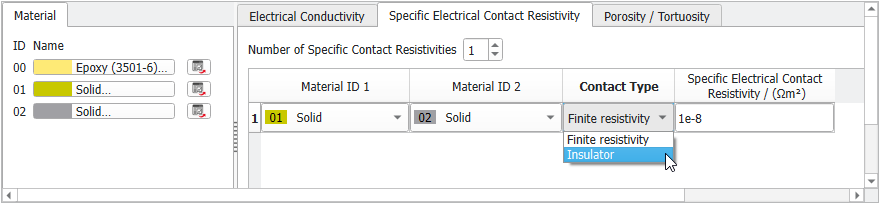
Contact resistances can be applied between the same Material IDs as well as between different material IDs. If the same material ID is chosen for Material ID 1 and Material ID 2, the contact resistance is applied only between different objects of the same color. There are two different ways how objects can be defined, for this see the description of the Object Mode of this user guide chapter.
If there are no contact resistances, just leave the Number of Specific Contact Resistivities to be 0.
|
Porosity / Tortuosity
If there is no porous material present in the structure, but only pure solid or fluid, you do not need to set any parameters on the Porosity / Tortuosity tab. When there is porous material, the Porosity, Tortuosity Factor of Pore-Space, and Has Solid Tortuosity become selectable. When Has Solid Tortuosity is checked, the value of Tortuosity Factor of Solid Phase can also be given. When you go back to the Electrical Conductivity tab, the different options for Mixing Rule are visible to choose for the porous medium, too. The description of the different rules are found in Mixing Rules for Effective Properties of Porous Media.
The results of different mixing rules on an example of 1 x 1 x 1 structure is found in Porosity / Tortuosity in the Compute Thermal Conductivity section.
|