General Options
Define the general parameters temperature, random seed and parallelization.

Temperature
When Grammage (or Density or Object Weight Percentage) is chosen as Stopping Criterion, a temperature can be entered. The temperature is considered for materials with temperature dependent density.
Choose the temperature in Kelvin, Celsius, or Fahrenheit.
Random Seed
Random Seed initializes the random number generator behind the structure generator. Changing its value produces different sequences of random numbers and hence, different realizations of the specified structure. If all settings are equal, generating with the same Random Seed value produces exactly the same structure, as shown by the Structure ID number in the Status section. The Random Seed is a non-negative integer number, it increases automatically with every generation run.
Varying the Random Seed allows generating different samples of the same structure for a series of experiments. In the following examples, all parameters are unchanged while the random seed is modified with every generation run.
Parallelization
Control how many threads are used for the computation. Parallelization is possible if your license and hardware allow it.
The Parallelization Options dialog opens when clicking the Edit button and you can choose between Sequential, Parallel (Shared Memory), or Automatic Maximum of Threads.

Selecting Sequential will not apply parallelization and only one thread is used for the computation.
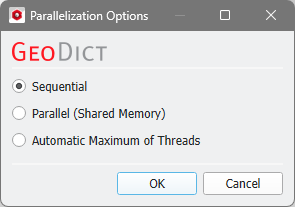
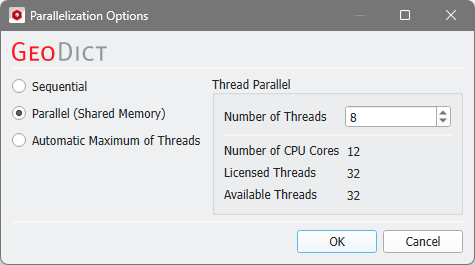
When Parallel (Shared Memory) is selected, the Number of Threads can be entered. Below, the Number of CPU Cores that the current machine has, the maximum number of Licensed Threads and the number of those licensed threads that are available (Available Threads) are shown in the dialog. Of course, the maximal number of parallel processes you can use, is the smallest of those three numbers.
If Automatic Maximum of Threads is selected, the number of parallel processes is automatically selected for optimal speed, based on the CPU cores and licensed parallel processes.
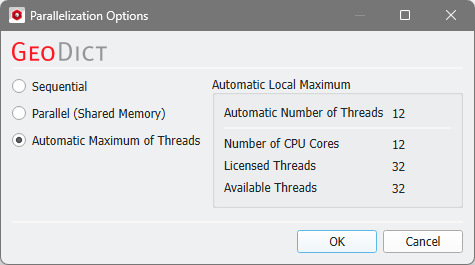
The Automatic Local Maximum of processes is automatically selected, which is the minimum of Number of CPU Cores, Licensed Threads, and Available Threads.
|
Parallelization Benchmark Results As an example for the parallelization, the complete overlap in a fiber structure is removed with different number of processes. The computation is run on a server with 2 x Intel E5-2697A v4 processors with 16 cores each, running with a maximum of 3.60 GHz, and 1 TB RAM. The large fiber structure has size 10003 voxels and 10 % solid volume percentage. Remove Overlap is used with stopping criterion 0% remaining overlap. The memory usage was 2.1 GB. As you can observe, the parallelization reduces the runtime significantly. With four processes, the runtime is already reduced by 70%. |