|
Navigation: GeoDict 2025 - User Guide > Image Analysis > GeoDict-AI > Apply Neural Network |
Scroll |
AI-Options
Set-up the material identification.
Initialization
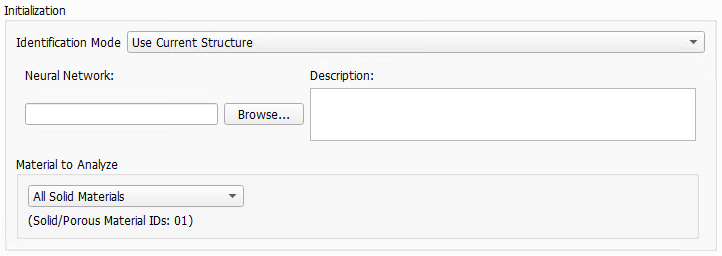
Two Identification Mode choices are available: Use Current Structure and Load Neural Network Output. The default Use Current Structure applies GeoDict-AI to the structure in memory. Occasionally, the Load Neural Network Output may be very useful, if different thresholds or confidence values should be tested, without having to run the identification for each voxel with the neural network again. Another application would be, that the identification was not finished, but an intermediate *.npz file is saved. This file can be loaded and thresholded to find out, if the identification is already good. A visualization of the confidence fields and the threshold is shown here.  Browse to a GeoDict result folder of a previous run of GeoDict-AI Apply Neural Network and select a nnOutput.npz file from that folder. Accordingly, the Material to Analyze and the Neural Network to be used cannot be changed, and the loaded structure needs to be the same. 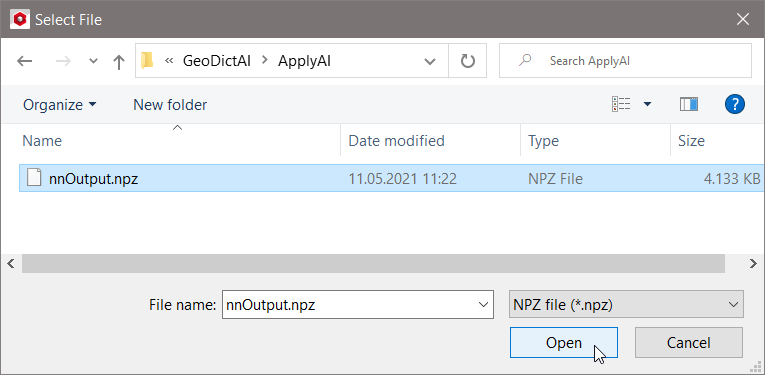 |
The Material to Analyze panel offers the choice of whether GeoDict-AI should be applied to all solids in the structure or only on a subset, defined either by choosing material IDs or materials.  If Chosen Material is selected, select the material to analyze from the pull-down menu on the right. All other materials will be considered as background by the neural network.  If Chosen Material IDs is selected, choose the material IDs to analyze from the pull-down menu on the right. All other material IDs will be considered as background by the neural network. |
 Neural Network and Description
Browse for the neural network trained with Train Neural Network and most suitable for the structure under consideration. For this, under Neural Network click Browse. Select a neural network *.gnn file, for example the BestModel.gnn from a prior training. 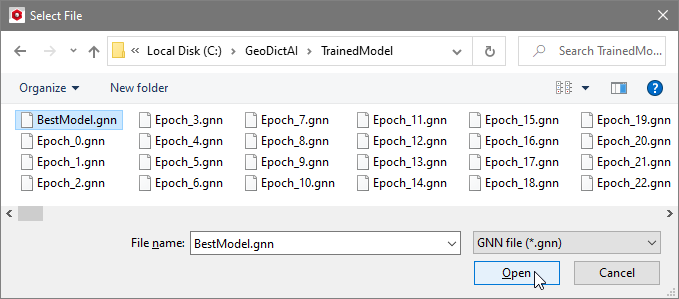 In the Description, the current constraints for the application of the neural network are listed, as entered in the Train Neural Network dialog, e.g. the diameter range of the fibers the neural network was trained for. |
Transforming confidence field to structure

The Threshold is an internal (or expert) parameter that is mostly applied by proficient users at Math2Market. The parameter is only available if the chosen network is trained to differentiate between two material phases. It is used for the decision whether a voxel is a target material voxel or not. If the identified features are over segmented, choosing a smaller threshold can lead to better results. For this, the confidence field (*.npz) can be loaded, without running the complete identification process again.  Find a visualization of the confidence field (*.npz) and threshold here. However, for most application cases, the default values can be kept, as the default threshold of 0.5 usually delivers good results for a well-trained network.
|

Specify the minimum required confidence to select a class for a voxel. The material to analyze should be split into different materials by the neural network. For each of the resulting materials a confidence field is computed. These fields contain values between 0 and 1, where 1 means, the neural network is perfectly sure, that this voxel should be assigned to the corresponding class and 0 means it is definitely not the corresponding class. If none of these fields has a higher probability value than specified the material will be set to uncertain in these locations and material ID 255 is assigned. The values of the confidence fields of all classes sum up to 1. Thus, not all confidence values can be smaller than 1/n, where n is the number of classes. That is why setting the Confidence value below 1/n will not have any impact. An example is shown here. |
Target Material sets the material assigned to the target material, e.g. the binder material. This parameter is only available, if only one target material should be found. For neural networks trained for more than one target material, this parameter disappears. The materials can be set afterwards using the Constituent Materials dialog. The Material Selector gives access to selecting the desired material from the GeoDict Material Database. When none of the materials available in the database fits the preferred specifications, Manual should be chosen. Alternatively, new materials can be defined in GeoDict’s material database (Click Edit Material Database…). See the Material Database handbook for more information. |
©2025 created by Math2Market GmbH / Imprint / Privacy Policy
