Image Segmentation
The Image Segmentation panel is organized into the following sections:
- Global Thresholding: Segment the image by setting either single or multiple gray-value thresholds. This is the fastest and simplest segmentation method.
- AI Segmentation: Train a custom neural network by labeling the gray value voxels in the image. Although more time is required for image labeling and training the model, this is a very powerful tool for images that are more difficult to segment.
- Multi-Phase Segmentation: Define confidence areas with gray value ranges. The areas in between are then computed with the watershed algorithm.
- Hysteresis Thresholding: Accomplish edge detection using two thresholds.
- Phansalkar: Deal with low contrast images using this local thresholding method.
- Local Otsu: Automatically perform clustering-based image thresholding using this local thresholding method.
Comparison of different segmentation methods
To compare the different segmentation methods, a Berea sandstone is segmented using Global Thresholding, Multi-Phase Segmentation, and AI Segmentation.
The sample is a Berea sandstone by Andrä et al. (1-2013, 2-2013). The dimensions of this dataset are 720x720x1024 voxels with a resolution of 0.74 µm. The material components are quartz, feldspar, calcite, and zircon.
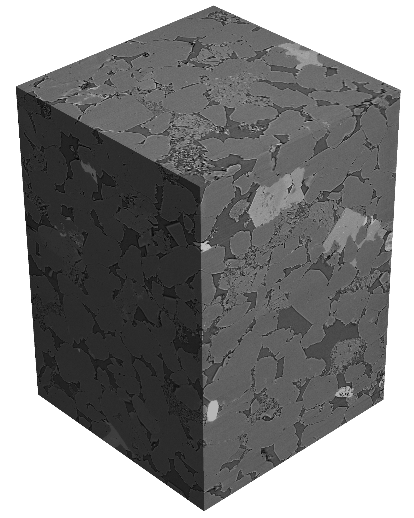
For the Berea sandstone, a parameter study was done comparing published experimental data to GeoDict results. Segmented porosity and computed (absolute) permeability are determined for the different segmentation methods. The results showed that (in this case) the Non-Local Means Filter, was not needed for the AI segmentation, but for the other two methods. Instead, after segmentation any remaining small-scaled features were reassigned with the ProcessGeo Cleanse feature.
The segmentation results for the different methods applied to the Berea sandstone look as follows:
In a visual comparison, the Global Thresholding result appears to be very similar to the AI Segmentation. The Multi-Phase Segmentation removes a major part of small-scale features. Thus, a reduced porosity is to be expected for this particular result.
The comparison study shows that all the above segmentation results are within experimentally obtained data. Consecutive flow computations performed via the FlowDict module result in (absolute) permeability values that are very well in the range of lab data published by Andrä et al. (2013). The entire study Impact of different segmentation methods on Digital Rock Analysis results was presented at the iRIS conference (international Rock Imaging Summit) in 2020 and is available from the GeoDict webpage here.
