Coalescence
|
This feature is only available with a separate license. Ask support(at)math2market.de if you are interested in obtaining a license. |

If the deposited particles are not solid, but liquid aerosols, they will not form a porous filter cake. Oncoming particles will coalesce with already deposited particles and form new and growing liquid droplets, that are attached to the filter media. Since GeoDict 2023 it is possible to model liquid aerosols and the subsequent coalescence process.
During flight, liquid droplets will be treated similar to the solid particles. Particle movement is modeled by GeoDict as described for solid dust particles. Also, the collisions are modeled as described for the solid particles.
After the movement and deposition of a batch of particles is simulated, the coalescence of the particles is considered: two particles touching each other will join and form a new particle that consists of the mass and center of gravity of both particles. The new particle is then placed on the filter media such that it respects the prescribed contact angle, which forms a flat film when having small contact angles and nearly spherical droplets when applying high contact angles.
After the coalescence of the particles is computed, the next batch of particles is simulated. Thus, the simulation of liquid aerosols follows the same scheme as the simulation of solid particles, but consists of one additional step: namely the modelling of the coalescence.
This approach is described in detail by Hoch, Weber and Niessner. In this article, a distance-map approach is proposed to describe droplet coalescence in fibrous filter media. The distance-map based approach is validated by comparing droplet shapes to those predicted by the VOF method. The distance-map approach is fast and easy since no conservation equations are solved for the liquid phase.
Enable Coalescence
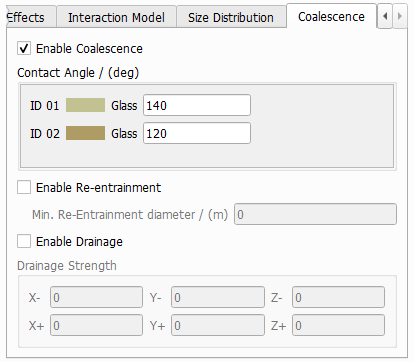
In the Coalescence tab, check Enable Coalescence to use this feature.
During the simulation, GeoDict assumes that all particles are resolved by the computational grid. Therefore, you cannot use this option if you selected Unresolved as Particle Resolution in the Constituent Materials tab.
For all material IDs representing solid filter material, select a Contact Angle. Contact angles above 90 degrees correspond to a wetting, i.e. hydrophilic (if the particles are water) or oleophilic (if the particles are oil) behavior, contact angles below 90 degrees correspond to a non-wetting, i.e. hydrophobic or oleophobic behavior.
When using this feature, small particles will coalesce into large droplets which are attached to the filter material. Be aware, that in the coalescence step, the complete deposited mass may be redistributed, which is a major difference to the behavior of solid particles in a filter cake. During a filter lifetime simulation, the liquid droplets on the filter material will continue to grow, and eventually block the filter completely (infinite pressure drop). This is different from the behavior of a filter cake of solid particles which is a porous material and always will let flow happen.
In industrial applications, coalescing filters typically achieve a steady state, where the pressure drop stays constant. This is achieved when the mass of small particles captured in a time interval matches the mass of large droplets that detach from the filter e.g. by gravitational effects.
To achieve a steady state also in the simulations, it is necessary to model also the detachment of droplets. Two mechanism have been implemented in GeoDict that allow to model the detachment of particles: Re-Entrainment and Drainage. Both mechanisms can be used to achieve a steady state. However, no validation has been done so far, so both features have to be considered as preliminary or experimental, and will be subject to change in future versions of GeoDict.
Enable Re-Entrainment (preliminary model)

Re-Entrainment enables the detachment of large liquid droplets from the filter media. Enter the minimal particle diameter required for particles to detach.
Enable Drainage (preliminary model)
Drainage enables the removal of liquid droplets adjacent to the side of the domain. The tooltip gives further explanations on the parameters.
Visualization of coalescence results
Be aware that due to the fluidization and redistribution of the deposited particles after each batch, some of the classically used visualization methods in GeoDict will not show the simulation results correctly. Read here how to visualize the results.
