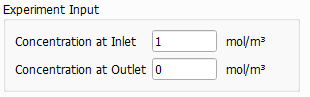
Besides the boundary conditions chosen for the main diffusion direction, the boundary conditions in the transverse (or tangential) directions can be set to be Periodic, Symmetric, Encase or Expert.
With Periodic boundary conditions, the structure is repeated in the transverse directions.
With Symmetric boundary conditions, the structure is mirrored at the domain boundary. The LIR and EJ solver solve the symmetric boundary condition by using Neumann (or zero flux) condition at the domain boundary.
With Encase, the domain boundary is treated as closed by solid material.
With Expert, it is possible to define different boundary conditions for each side in each computation:
When Encase is used, the solver internally adds a one-voxel layer in the required direction and solves with periodic boundary conditions. That effectively is equivalent to solve the structure with casing in two ends in the direction of interest. So, the size of computation in this direction becomes n+1. However, if changing the computational size is not preferable, using Encase (fixed domain size) can avoid that, then the first layer of the structure is replaced by a non-diffusing material.
|