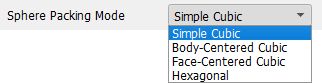
With Grid of Spheres, sphere lattices of the four most common types can be generated. These are chosen from the Sphere Packing Mode drop down menu.
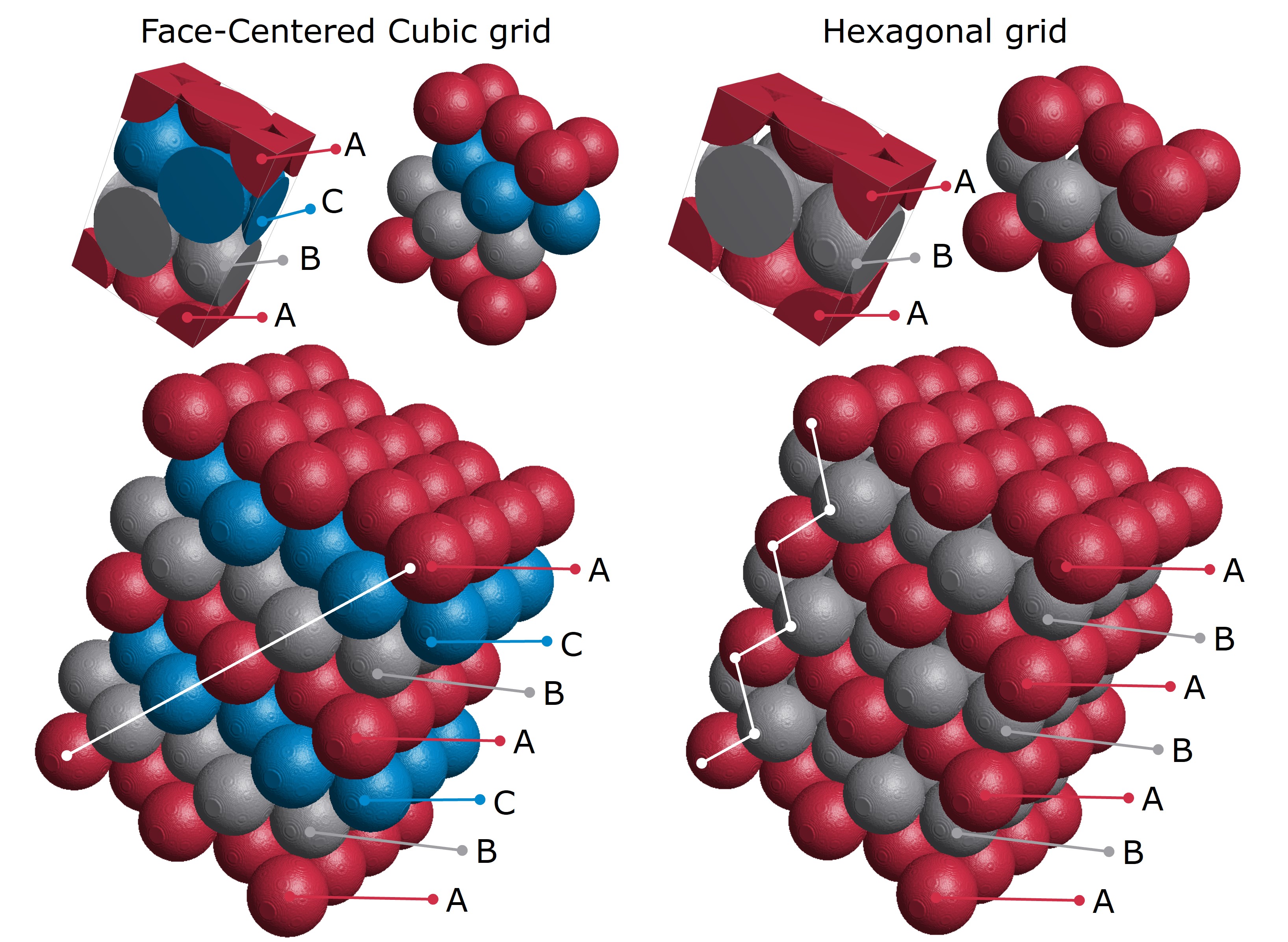
Below, for every available grid, one unit cell is shown. The left figure shows the packing, where the spheres are cut at the boundary of the unit cell domain. The right figure shows the packing with the whole spheres. Additionally, the highest achieved packing density without overlapping spheres is given. The highest packing density for any grid type will be reached in the Touching Configuration. In the Face-Centered Cubic and the Hexagonal grid the highest possible packing density can be achieved.
In the Face-Centered Cubic grid, one sphere is located at each corner of the unit cell, and one at each face of the cube. The achieved packing density is the highest possible value for all types of grids with equal diameter spheres.
(32) Highest achievable packing density in FCC-grid
In the Hexagonal grid, layers of hexagonally arranged spheres are stacked on top of each other. In the figure on the right-hand side, the first layer (A) consists of the red and gray spheres, while the second (B) consists of the blue and orange spheres. Each layer fits perfectly in the “gaps” of the preceding layer and vice versa.
(33) Highest achievable packing density in Hexagonal-grid
The unit cell length in Z-direction in the Hexagonal grid is times the sphere diameter.
The Face-Centered Cubic and Hexagonal grids are strongly related: both have a packing density of . In the first figure, 3x3x3 Face-Centered Cubic unit cells are displayed: a) shows the usual color scheme with different colors for the corner spheres and each of the cube faces. In b), the same structure is shown, but now diagonal layers become visible. In c) only the red layers from b) are shown and the hexagonal structure becomes visible. The Face-Centered Cubic grid consists of hexagonal layers stacked upon each other – like the Hexagonal grid.
So, a Face-Centered Cubic is also a Hexagonal grid – what is the difference? It becomes apparent in the next figure.
The Face-Centered Cubic grid consists of three hexagonal layers (A-B-C). The relation from layer to layer is always the same (observe the white line). The Hexagonal grid has two layers (A-B), where the stacking direction changes from layer to layer.
Size of the unit cell
Before the size of the unit cell is set, the Sphere Diameter should be entered. It defines the diameter of the spheres in the grid and it is equal for all spheres.
The size of the unit cell can then be determined in two different ways.
The easiest way is to specify the Unit Cell Length, which defines the length of the unit cell in X-direction. For the Simple Cubic, Body-Centered Cubic and Face-Centered Cubic grid types this defines also the length of the unit cell in Y-, and Z-direction, respectively. For the Hexagonal grid, the unit cell is a cuboid, therefore, the unit cell length only gives the length of the unit cell in X-direction. The length in Z-direction is obtained by multiplying the length in X-direction with .
Important! For hexagonal grids, it is not possible to achieve the exact side lengths of the (theoretical) cuboid unit cell with cubic voxels. Therefore, GridGeo approximates the unit cell in the given resolution. This leads to a slightly different unit cell size for different resolutions, and therefore the resulting positions of the spheres will depend on the selected resolution. Furthermore, it is possible that in some cases the spheres may slightly overlap, even for cases where a Touching Configuration was selected.
The other way is to define the Sphere Center Distance, which is the distance between neighboring sphere centers in the grid. The resulting unit cell size depends on the chosen Sphere Packing Mode.
Checking Touching Configuration sets the Sphere Diameter equal to the Sphere Center Distance, so that the spheres in the lattice touch perfectly.
The parameters Sphere Diameter and Sphere Center Distance should always be chosen in combination.
In the next figure, their relation is illustrated: Choosing the sphere diameter smaller than the sphere center distance leads to empty space between all spheres in the grid and choosing it larger leads to overlapping spheres.
The minimal distance between spheres in the selected grid occurs when the Sphere Diameter is chosen equal to the Sphere Center Distance. In this case, the touching configuration is realized: spheres touch and no overlaps occur.
 Simple Cubic Grid (SC)